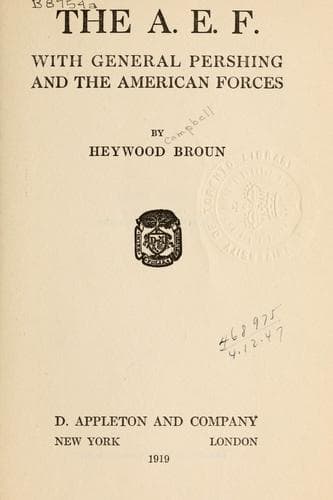
The A. E. F.: With General Pershing and the American ForcesBroun, Heywood
History
The A. E. F.: With General Pershing and the American Forces
Broun, Heywood
United States. Army. American Expeditionary Forces; World War, 1914-1918 -- Personal narratives
We followed the students from bombs to bayonets. The men with the cold
steel were charging into dummies marked with circles to represent spots
where hits were likely to be vital. It looked for all the world like
football practice and the men went after the dummies as the tacklers
used to do at Soldiers' Field of an afternoon when the coach had pinned
blue sweaters and white "Y's" on the straw men. There was the same
severely serious spirit. In a larger field a big class was having
instruction in attack. Before them were three lines of trenches
protected by barbed wire ankle high. At a signal they left their trench
and darted forward to the next one. Here they paused for a moment and
then set sail for the second trench. At another signal they were out of
that and into a third trench. From here they blazed away at some targets
on the hill representing Germans and consolidated their positions.
Instructors followed the charge along the road which bordered the
instruction field. They mingled praise and blame, but ever they shouted
for speed. "Make this go now," would be the cry, and to a luckless wight
who had been upset by barbed wire and sent sprawling: "What do you mean
by lying there, anyhow?"
It was a New Zealand company which I saw, and in the class were a number
of Maoris. These were fine, husky men of the type seen in the Hawaiian
Islands. All played the game hard, but none seemed so imaginatively
stirred by it as the Maoris. They were fairly carried away by the
enthusiasm of a charge, and left their trenches each time shouting at
top voice. The capture of the third trench by no means satisfied them.
They wanted to go on and on. If the officer had not called a halt
there's no telling but that they might have invaded the next field and
bayoneted the bombardiers. Over the hill there was a rattle of machine
guns and beyond that a more scattering volume of musketry. We stopped
and watched the men at their rifle practice.
"You wouldn't believe it," said the instructor, "but we've got to keep
hammering it home to men that rifles are meant to shoot with. For a time
you heard nothing but bayonets. A gun might have been nothing more than
a pike. Later everything was bombs, and sometimes soldiers just stood
and waited till the Boches got close, so that they could peg something
at 'em. But when these men go away they're going to know that the bombs
and the bayonet are the frill. It's the shooting that counts."
Public-domain text, read in full here on John Shaqi.
Reviews
Reviews
No reviews yet
Be the first to share your thoughts on this work.
Elsewhere in the archive
Join the Discussion
Join the discussion
Sign in to leave a comment or review.
Sign InorCreate an account