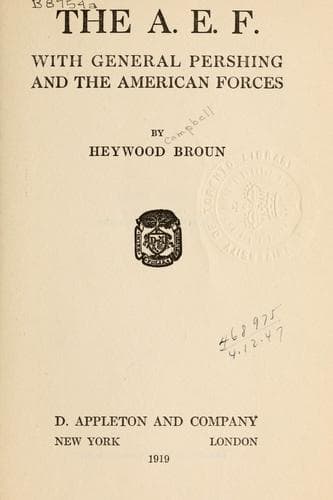
The A. E. F.: With General Pershing and the American ForcesBroun, Heywood
History
The A. E. F.: With General Pershing and the American Forces
Broun, Heywood
United States. Army. American Expeditionary Forces; World War, 1914-1918 -- Personal narratives
During the latter part of the training period the home dinner was often
omitted in favor of a meal prepared at the training ground. The
afternoon work began a little before two. Rifle practice, drills and
bayonet work were usually the phases of warfare undertaken at this time
of day. Labor ceased at four with supper, which was much the same sort
of meal as dinner, at five-thirty. After supper the soldier's time was
pretty much his own. He could loaf about the town hall and listen to the
army band play selections from "The Fair Co-ed," "The Prince of Pilsen"
or any one of a score of comic operas long dead and forgotten by
everyone but army bandmasters, or he could go to the Y.M.C.A. and read
or write letters or play checkers or perhaps pool of the sort which is
possible on a small portable table. He was due back in quarters and in
bed at nine and he was always asleep at one minute and thirty seconds
after nine.
The training hours became more crowded, if not longer, as the time drew
nearer when the American army should go to the front. Everybody was
anxious that they should make a good showing. Trench problems had to be
considered and gas and bayonet work which was the phase in which the
training was lagging somewhat. It was also considered useful that the
men should have some experience with shell fire before they heard guns
fired in anger, and so it was arranged that a sham battle should take
place in which the French would fire a barrage over the heads of the
American troops. The first plan was that the doughboys should advance
behind this barrage as in actual warfare and attack a system of practice
trenches. Later it was decided that it was not worth while to risk
possible casualties, as the men could learn almost as much although held
four or five hundred yards behind the barrage.
The bombardment began with thirty-six shots to the minute and was
gradually raised to fifty-two. The doughboys were allowed to sit down to
watch the show. Our soldiers seemed a bit unfeeling, for not one
expressed any regret at the destruction of Hindenburg, Ludendorff, and
Mackensen, although they had spent many a happy afternoon under the
broiling sun constructing this elaborate trench system. None of the men
seemed disturbed, either, by the unfamiliar whistling sounds over head.
All the doughboys wore steel helmets but two were slightly injured by
small fragments from shells which fell a little short. In both cases the
wounded man had lowered the protective value of his helmet somewhat by
sitting on it. After the first interest in the show wore off many proved
their ability to steal naps in spite of the bickering of the big guns.
The marines, for instance, had marched eighteen miles after rising at
3:30 in the morning, and although the marine corps is singularly hardy,
a few made up lost sleep. The patter of the French seventy-fives was no
more than rain on the roof to these men when they could find sufficient
cover to sleep unobserved.
Public-domain text, read in full here on John Shaqi.
Reviews
Reviews
No reviews yet
Be the first to share your thoughts on this work.
Elsewhere in the archive
Join the Discussion
Join the discussion
Sign in to leave a comment or review.
Sign InorCreate an account