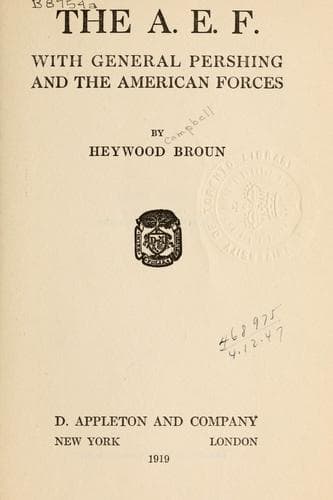
The A. E. F.: With General Pershing and the American ForcesBroun, Heywood
History
The A. E. F.: With General Pershing and the American Forces
Broun, Heywood
United States. Army. American Expeditionary Forces; World War, 1914-1918 -- Personal narratives
By October much of the feeling between the officers of the regular army
and the reserve had been smoothed out, but it was not like that in the
early days. Once when a young reserve major was put in command of a
battalion, a regular army captain who was much his senior in years
observed: "I think there ought to be an army regulation that no reserve
officer shall be appointed to command a battalion without the consent of
his parents or guardian." But as the work grew harder and harder many
little jealousies of the army were simply sweated out. It was easy to do
that, for the American army woke up, or rather was awakened, every
morning at five o'clock. There was a Kansas farmer in one company who
was always up and waiting for the buglers. He said that the schedule of
the American army always left him at a loss as to what to do with his
mornings. But for the rest the trumpeters were compelled to blow their
loudest. Roll call was at five-thirty and this was followed with setting
up exercises designed to give the men an appetite for the six o'clock
breakfast. This was almost always a hearty meal. The poilus who began
the day with a cup of black coffee and a little war bread were amazed to
see the doughboys start off at daylight with Irish stew, or bacon or ham
or mush and occasionally eggs in addition to white bread and coffee.
After breakfast came sick call, at which men who felt unable to drill
for any reason were obliged to talk it over with the doctor. Those who
had no ailments went to work vigorously in making up their cots and
cleaning their quarters. At seven they fell in and marched away to the
training ground. Mornings were usually devoted to bombing, machine gun
and automatic rifle practice. A little after eleven the doughboys
started back to their billets for dinner. This was likely to consist of
beans and boiled beef or salmon, or there would be a stew again or
corned beef hash. The most prevalent vegetables were potatoes and canned
corn. Dinner might also include a pudding, nearly always rice or canned
fruit. Sometimes there was jam and, of course, coffee and bread were
abundant.
Public-domain text, read in full here on John Shaqi.
Reviews
Reviews
No reviews yet
Be the first to share your thoughts on this work.
Elsewhere in the archive
Join the Discussion
Join the discussion
Sign in to leave a comment or review.
Sign InorCreate an account