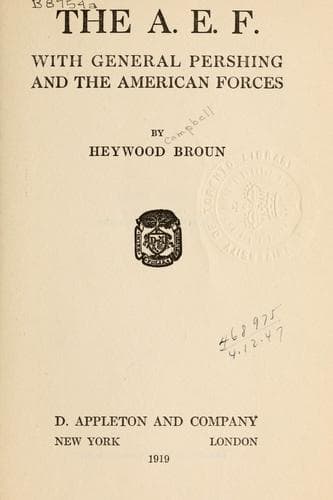
The A. E. F.: With General Pershing and the American ForcesBroun, Heywood
History
The A. E. F.: With General Pershing and the American Forces
Broun, Heywood
United States. Army. American Expeditionary Forces; World War, 1914-1918 -- Personal narratives
Later in the day the town was full of the eddies which occur when two
languages meet head on, for almost all the soldiers and sailors received
leave to come to town. They wanted beer and champagne and cognac,
chocolate, cake, crackers, pears, apples, cherries, picture postcards,
sardines, rings, cigarettes, and books of French and English phrases.
The phrase books were usually an afterthought, so commerce was
conducted with difficulty. A few of the shopkeepers equipped themselves
with dictionaries and painstakingly worked out the proper reply for each
customer. Signs were much more effective and when it came to purchase,
the sailor or soldier simply held out a handful of American money and
the storekeeper took a little. To the credit of the shopkeepers of the
nameless port, let it be said that they seemed in every case to take no
more than an approximation of the right amount. Fortunately the late
unpleasantness at Babel was not absolutely thoroughgoing and there are
words in French which offer no great difficulty to the American. The
entente cordiale is furthered by words such as "chocolat," "sandwich,"
"biere" and "bifstek." The difficulties of "vin" are not insurmountable
either.
"A funny people," was the comment of one doughboy, "when I ask for
'sardines' I get 'em all right, but when I say 'cheese' or 'canned
peaches' I don't get anything."
Another complained, "I don't understand these people at all. They spell
some of their words all right, but they haven't got the sense to say 'em
that way." He could see no reason why "vin" should sound like "van."
Another objection of the invading army was that the townsfolk demanded
whole sentences of French. Mixtures seemed incomprehensible to them and
the officer who kept crying out, "Madame, where are my oeufs?" got no
satisfaction whatever.
Late in the afternoon phrase books began to appear, but they did not
help a great deal because by the time the right phrase had been found
some fellow who used only sign language had slipped in ahead of the
student. Then, too, some of the books seemed hardly adapted for present
conditions. One officer was distinctly annoyed because the first
sentence he found in a chapter headed war terms was, "Where is the grand
stand?" But the book which seemed to fall furthest short of promise was
a pamphlet entitled, "Just the French You Want to Know."
Public-domain text, read in full here on John Shaqi.
Reviews
Reviews
No reviews yet
Be the first to share your thoughts on this work.
Join the Discussion
Join the discussion
Sign in to leave a comment or review.
Sign InorCreate an account