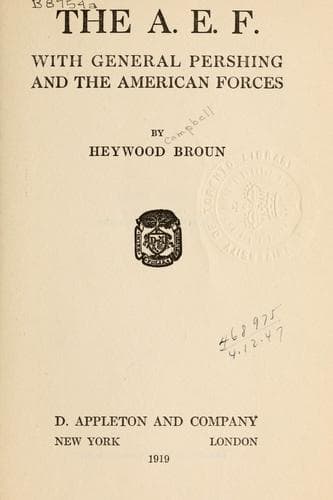
The A. E. F.: With General Pershing and the American ForcesBroun, Heywood
History
The A. E. F.: With General Pershing and the American Forces
Broun, Heywood
United States. Army. American Expeditionary Forces; World War, 1914-1918 -- Personal narratives
There was other practice which seemed less warlike. Particular attention
was paid to signaling and men on hilltops stood and waved their arms at
each other from dawn until sunset. I stood one bright day with an expert
who was trying the utmost capacity of the man stationed on the hill
across the valley. The officer made the little flags whirl through the
air like bunting on a battleship. He looked across the peaceful
countryside and saw war dangers on every hand. The gas attack which his
flags predicted seemed nothing more to me than the dust raised by a
passing army truck. He signaled that the tanks were coming, but they
mooed as they moved and the aeroplanes of which he spoke in dots and
dashes cawed most distinctly. With a twist of his wrist he would summon
a battery and with another send them back again. There was an emphatic
whip and swirl of color, and in answer to the signal mythical infantry
swarmed over theoretical trenches to attack shadow soldiers. The task of
the receiving soldier was made more difficult because every now and then
the officer would vary his military messages with "Double-header at the
Polo Grounds today" or "Please pass the biscuits." But the soldier read
them all correctly. Biscuits were just as easy for him as bullets.
The men were also tested for their ability to carry oral messages. As a
result of this drill there were several new mule drivers. The test
message was, "Major Blank sends his compliments to Captain Nameless and
orders him to move L company one-half mile to the east and support K
company in the attack." After giving out this message the officer moved
to the top of a hill to receive it. The first soldier who came up had
difficulty in delivering the message because English seemed more alien
to him than Italian. He had it all right at that, except that he made it
a mile and a half. The next three delivered the message correctly, but
then a large soldier came panting up, fairly bursting with excitement,
and exclaimed: "The major says he hopes you're feeling all right and
please take your company a mile to the east and attack K company." The
names of such careless messengers were noted down so that they might not
cause blunders in battle.
Precaution was taken against another source of mistakes by sending
American officers out to drill French units. A few found no trouble in
giving orders which the poilus could understand, but some had bad cases
of stage fright.
Public-domain text, read in full here on John Shaqi.
Reviews
Reviews
No reviews yet
Be the first to share your thoughts on this work.
Elsewhere in the archive
Join the Discussion
Join the discussion
Sign in to leave a comment or review.
Sign InorCreate an account