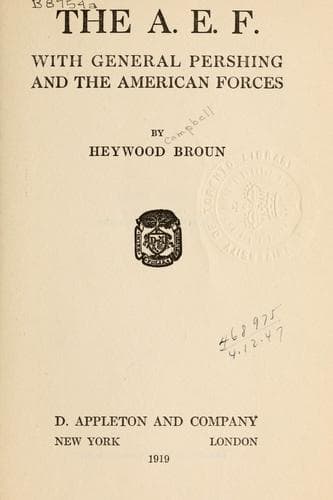
The A. E. F.: With General Pershing and the American ForcesBroun, Heywood
History
The A. E. F.: With General Pershing and the American Forces
Broun, Heywood
United States. Army. American Expeditionary Forces; World War, 1914-1918 -- Personal narratives
The last set event of the training period was a big field meet in which
picked companies competed in military events. The meet began with
musketry and worked through bayonets, hand grenades, automatic rifles,
and machine guns, ending with trench digging. It was supposed that this
would be the least exciting, but two companies came up to the last event
tied for the point trophy. Honor and a big silver trophy and everything
hung on this last event and the men could not have worked harder if they
had been under German shellfire. Partisans of both sides stood nearby
and shouted encouragement to their friends and heavy banter at the foe.
There was organized cheering and singing, too, and a couple of bands
blared while the competitors lay prone and hacked away at the tough
soil. One band played "Won't You Come and Waltz With Me?" while the
other favored "Sweet Rosie O'Grady." Neither seemed particularly
pertinent, but there wasn't much sense of the appropriate in the third
band, either, which played "Dearie," while the soldiers were stabbing
imitation Boches in the bayonet contest.
The champions of the pick and shovel brushed some of the dirt off their
uniforms and lined up to receive the prize, which was a big silver salad
bowl. The best bayoneters got a sugar shaker and there were mugs and
wrist watches and plain watches and all sorts of things from the
commander and from General Sibert and General Castelnau. No sooner were
the prizes distributed than news came that the White Sox had won the
first game of the world series from the Giants and then there was more
cheering. The winning company went back to camp in a big truck loudly
and tunefully proclaiming to the natives: "We got style, all the while,
all the while."
The Germans contributed one post graduate phase of training which was
not on the program. Shortly before the troops went to the front a
Zeppelin was brought down in a town within marching distance of the
American training zone. The big balloon could not have been better
placed if its landing had been directed by a Coney Island showman. It
was perched on two hills just by the side of a road and visitors came
from miles about to look at the monster. Early comers reaped a rich
harvest of souvenirs. "I only had to get three more screws loose and I'd
have had the steering wheel if a French soldier hadn't come up and
stopped me," complained an American correspondent.
The chasseurs left to go back into the line before the Americans started
for the front. The departure of the chasseurs caused genuine regret, for
in addition to a profound respect for their military ability, the
American officers and men had a warm personal feeling for the troops who
taught them the first rudiments of the modern art of war. In all the
camps there were ceremonies for the soldiers who were leaving drills and
practice attacks and sham battles to go back wherever shock troops were
needed.
Public-domain text, read in full here on John Shaqi.
Reviews
Reviews
No reviews yet
Be the first to share your thoughts on this work.
Elsewhere in the archive
Join the Discussion
Join the discussion
Sign in to leave a comment or review.
Sign InorCreate an account