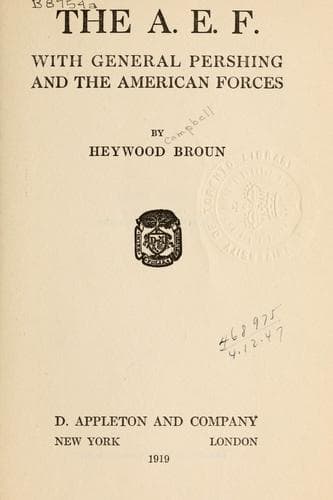
The A. E. F.: With General Pershing and the American ForcesBroun, Heywood
History
The A. E. F.: With General Pershing and the American Forces
Broun, Heywood
United States. Army. American Expeditionary Forces; World War, 1914-1918 -- Personal narratives
And bye-and-bye the insinuation began to take effect. The little man had
spent two years on the line and it was easy to see that bit by bit he
was beginning to visualize the stick with a cloth knob as a Boche
adversary. His thrusts grew fiercer and fiercer. The point of his
bayonet flashed into the cloth knob again and again. He was trembling
with rage as he played the battle game. As he finally flung himself upon
the stick and knocked it out of the major's hands the officer called a
halt.
"There," he said to the Americans, "if your men are to train well,
you've got to make them believe it's true, and you can do it."
The British added lots of snap to the American training because they
knew how to arouse the competitive spirit. They made even the most
routine sort of a drill a game, and whether the men were bayoneting
dummies or shooting at tin cans the little Britishers kept them at top
speed by stirring up rivalry between the various organizations.
Sometimes the slang was a bit puzzling. The marines, for instance,
didn't know just what their bayonet instructor meant when he said: "Come
on, you dreadnoughts, give 'em the old 'kamerad.'"
Curiously enough the other specialty in addition to bayonet work which
the British taught the doughboys was organized recreation. Thus a
British sergeant would take his squad from practicing the grimmest
feature of all war training and set the men to tossing beanbags or
playing leapfrog. Prisoner's base, red rover and a score of games played
in the streets of every American city were used to bring relaxation to
the soldiers. There were other rough and tumble games in which the
players buffeted each other assiduously in a neutral part of the body
with knotted towels. The emphasis was put upon the ludicrous in all
these games.
"This may seem childish and silly to you," said the major, "but we have
found on the line that the quickest way to bring back the spirit of a
regiment which has been battered in battle is to take the men as soon as
they come from the trenches and set them to playing these foolish little
games which they knew when they were lads. When we get them to laughing
again we know we've made them forget the fight."
Mostly it wasn't play. There were long mornings and afternoons spent in
battalion problems in which the doughboys again and again captured the
position made up of the trenches Roosevelt, Taft and Wilson. One general
pointed out that communication between Roosevelt and Taft would be
necessarily difficult and between Roosevelt and Wilson all but
impossible. The doughboys overcame these difficulties as they advanced
under theoretical barrages and hurled live bombs into the trenches or
thereabouts.
Public-domain text, read in full here on John Shaqi.
Reviews
Reviews
No reviews yet
Be the first to share your thoughts on this work.
Elsewhere in the archive
Join the Discussion
Join the discussion
Sign in to leave a comment or review.
Sign InorCreate an account