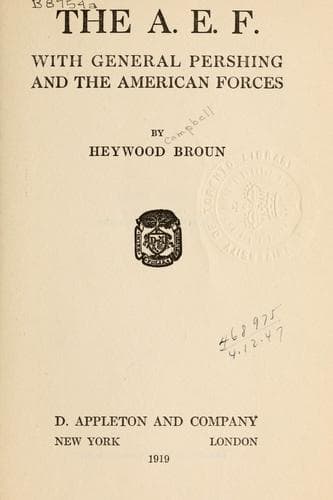
The A. E. F.: With General Pershing and the American ForcesBroun, Heywood
History
The A. E. F.: With General Pershing and the American Forces
Broun, Heywood
United States. Army. American Expeditionary Forces; World War, 1914-1918 -- Personal narratives
We turned back toward the town and left the major at his post still
listening for some sound from up there. Soon we heard a noise, but it
came from the opposite direction. Soldiers were coming. There was a bend
in the road where it straightened out in the last two miles to the
trenches. It was so dark that we could not see the men until they were
almost up to us. The Americans were marching to the front. The French
had instructed them and the British and now they were ready to learn
just what the Germans could teach them.
The night was as thick as the mud. The darkness seemed to close behind
each line of men as they went by. Even the usual marching rhythm was
missing. The mud took care of that. The doughboys would have sung if
they could. Shells wouldn't have been much worse than the silence. One
soldier did begin in a low voice, "Tramp, tramp, tramp, the boys are
marching." An officer called, "Cut out that noise." There was no tramp,
tramp, tramp on that road. Feet came down squish, squish, squish. There
was also the sound of the wind. That wasn't very cheerful, either, for
it was rising and beginning to moan a little. It seemed to get hold of
the darkness and pile it up in drifts against the camouflage screens
which lined the road.
At the spot where the road turned there was a café and across the road
a military moving picture theater. The door of the café was open and a
big patch of light fell across the road. The doughboys had to go through
the patch of light and it was almost impossible not to turn a bit and
look through the door. There was red wine and white to be had for the
asking there, and persuasion would bring an omelette. The waitress was
named Marie, but they called her Madelon. She was eighteen and had black
hair with red ribbons. She could talk a little English, too, but nobody
came to the door of the café to see the soldiers go by. There had been a
good many who passed the door of that café in three years.
Public-domain text, read in full here on John Shaqi.
Reviews
Reviews
No reviews yet
Be the first to share your thoughts on this work.
Elsewhere in the archive
Join the Discussion
Join the discussion
Sign in to leave a comment or review.
Sign InorCreate an account