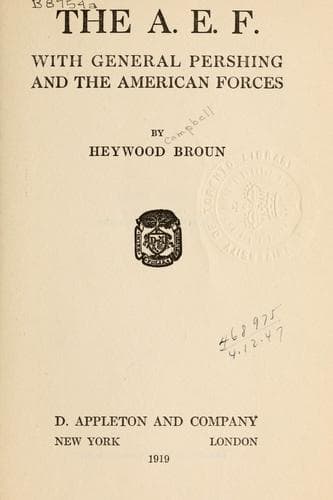
The A. E. F.: With General Pershing and the American ForcesBroun, Heywood
History
The A. E. F.: With General Pershing and the American Forces
Broun, Heywood
United States. Army. American Expeditionary Forces; World War, 1914-1918 -- Personal narratives
The pictures could not be seen from the road, but we could hear the hum
of the machine which made them move. Presently, we went to the door and
looked. The theater was packed with French soldiers who were back from
the front to rest. American troops were going into the trenches for the
first time. Our little group of civilians had come thousands of miles to
see this thing, but the poilus did not stop to watch marching men. They
paid their 10 centimes and went into the picture show. They had an
American Western film that night, and French soldiers who only the day
before had been face to face with Germans, shelled and gassed and
harassed from aeroplanes, thrilled as Indians chased cowboys across a
canvas screen. It grew more exciting presently, for the United States
cavalry came riding up across the screen and at the head of the
cavalcade rode Lieutenant Wallace Kirke. The villain had spread the
story that he wasn't game, but there was nothing to that. The poilus
realized that before the film was done and so did the Indians.
Meanwhile the doughboys were marching by as silently as the soldiers on
the screen, for this wasn't a movie-house where they synchronized bugle
calls and rifle fire to the progress of the film. At one point in the
story there was some gun thunder, but it came at a time when the
orchestra should have been playing "Hearts and Flowers" for the love
scene in the garden. Of course, these were German guns, and they were
fired with the usual German disregard for art.
Probably the men who were marching to the trenches would have enjoyed
the scene of the home-coming of the cavalry, when Lieutenant Wallace
Kirke confounded the villain, who actually held a commission as major in
the United States army. However, the doughboys might have spotted him
for a villain from the beginning, on account of his wretched saluting.
The director should have spoken to him about that.
The marching men looked at the theater as they passed by, but only one
soldier spoke. He said: "I certainly would like to know for sure whether
I'll ever get to go to the movies again."
They went a couple of hundred yards more without a word, and then a
soldier who couldn't stand the silence any longer shouted, "Whoopee!
Whoopee!" It was too dark to conduct an investigation and too close to
the line to administer any rebuke loud enough to be effective, and so
the nearest officer just glared in the general direction of the
offender. A little bit further on the soldiers found that the road was
pock-marked here and there with shell holes. They began to realize the
importance of silence then, for they knew that where a shell had gone
once it could go again. It was necessary to walk carefully, for the road
was covered with casual water in every hollow, and there was no seeing a
hole until you stepped in it. They managed, however, to avoid the deeper
holes and to jump most of the pools.
Public-domain text, read in full here on John Shaqi.
Reviews
Reviews
No reviews yet
Be the first to share your thoughts on this work.
Elsewhere in the archive
Join the Discussion
Join the discussion
Sign in to leave a comment or review.
Sign InorCreate an account