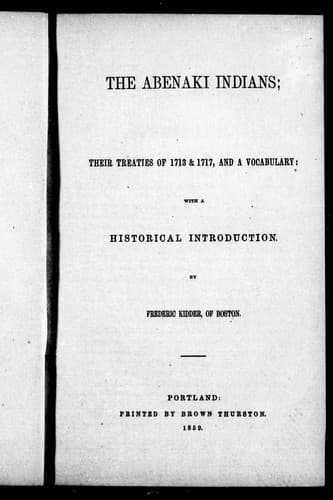
The Abenaki Indians: Their Treaties of 1713 & 1717, and a VocabularyKidder, Frederic
History
The Abenaki Indians: Their Treaties of 1713 & 1717, and a Vocabulary
Kidder, Frederic
Abenaki Indians; Abenaki Indians -- Treaties; Abenaki language
In 1755 they were again in the field, and followed the French armies to
the head of Lake George, and carried terror into the new townships on
the Connecticut river. Some of their small parties at that late day
penetrated within sixty miles of the capital of New England. But these
long continued aggressions were soon to meet a fearful retribution. The
capture of Quebec, which gave North America to England, had changed the
relation of the Abenakis. Capt. Kennedy having been sent to their
villages with a flag of truce, was, with his whole party, made
prisoners. To chastise them for this outrage, as well as to retaliate
for their continued cruelty and murders on the defenseless frontier
settlements, Gen. Amherst dispatched the celebrated Major Rogers with a
detachment of his rangers to the villages on the St. Francis. Just
before daybreak, on the fifth of October, he surprised and killed at
least two hundred Indians, and burnt all their wigwams, plunder, and
effects. Rogers in his journal says: "To my own knowledge, in six years'
time, the St. Francis Indians had killed and carried into captivity on
the frontiers of New England, four hundred persons; we found in the
town, hanging on poles over the doors &c., about six hundred scalps,
mostly English."
The power of the tribe for evil was gone, and we hear no more of them
till the Revolution, when their warriors followed Burgoyne to Saratoga,
where they again used the tomahawk and scalping knife, but when his
fortunes began to wane, they retired to the banks of the St. Lawrence.
Again in the war of 1812, they joined the English, but their numbers
were few, and after a brief campaign, they, for the last time, retraced
their steps to their own homes.
A few more remarks will close the history of this tribe, once the terror
of New England.
The present condition of the Abenakis is given in a report made in 1858
to the Legislative Assembly of Canada. This states that the tribe on the
St. Francis has diminished to three hundred and eighty-seven persons;
they live mainly by agriculture, but everything is done in so rude a
way, that they gather but scanty crops. Part of them, through the
exertions of one of their own number, have been induced to discard their
ancient faith, and are now professed Methodists. This change has
involved the tribe in continual feuds and difficulties, which will
prevent any improvement, and will probably lead to a permanent division
and removal of one of the parties. They often undergo much privation for
want of proper food and other necessaries of life. The portion of the
tribe at Beçancour presents a still more degraded condition. There
remain but thirty families, in all one hundred and seventy-two
individuals. They still remain Roman Catholics, have no schools, and
seem to have reached the extreme of misery and destitution, and so
completely have this people intermixed, that their missionary writes,
"he does not know of a single pure Abenaki among them."
Public-domain text, read in full here on John Shaqi.
Reviews
Reviews
No reviews yet
Be the first to share your thoughts on this work.
Join the Discussion
Join the discussion
Sign in to leave a comment or review.
Sign InorCreate an account