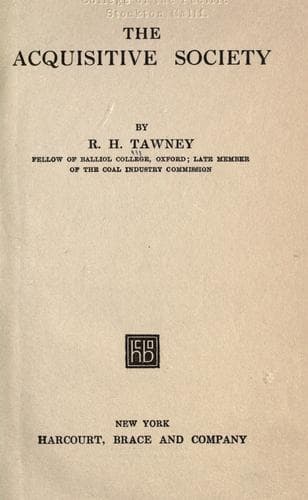
The Acquisitive SocietyTawney, R. H. (Richard Henry)
Philosophy
The Acquisitive Society
Tawney, R. H. (Richard Henry)
Economics; Industries; Social problems
The ideal of some intelligent and respectable business men, the
restoration of the golden sixties, when workmen were docile and
confiding, and trade unions were still half illegal, and foreign
competition meant English competition in foreign countries, and prices
were rising a little and not rising too much, is the one Utopia which
can never be realized. The King may walk naked as long as his
courtiers protest that he is clad; but when a child or a fool has
broken the spell a tailor is more important than all their admiration.
If the public, which suffers from the slackening of economic activity,
{146} desires to end its _malaise_, it will not laud as admirable and
all-sufficient the operation of motives which are plainly ceasing to
move. It will seek to liberate new motives and to enlist them in its
service. It will endeavor to find an alternative to incentives which
were always degrading, to those who used them as much as to those upon
whom they were used, and which now are adequate incentives no longer.
And the alternative to the discipline which Capitalism exercised
through its instruments of unemployment and starvation is the
self-discipline of responsibility and professional pride.
So the demand which aims at stronger organization, fuller
responsibility, larger powers for the sake of the producer as a
condition of economic liberty, the demand for freedom, is not
antithetic to the demand for more effective work and increased output
which is being made in the interests of the consumer. It is
complementary to it, as the insistence by a body of professional men,
whether doctors or university teachers, on the maintenance of their
professional independence and dignity against attempts to cheapen the
service is not hostile to an efficient service, but, in the long run, a
condition of it. The course of wisdom for the consumer would be to
hasten, so far as he can, the transition. For, as at present
conducted, industry is working against the grain. It is compassing sea
and land in its efforts to overcome, by ingenious financial and
technical expedients, obstacles which should never have existed. It is
trying to produce its results by conquering professional feeling
instead of using it. It is carrying not only its inevitable economic
burdens, but an ever increasing {147} load of ill will and skepticism.
It has in fact "shot the bird which caused the wind to blow" and goes
about its business with the corpse round its neck. Compared with that
psychological incubus, the technical deficiencies of industry, serious
though they often are, are a bagatelle, and the business men who preach
the gospel of production without offering any plan for dealing with
what is now the central fact in the economic situation, resemble a
Christian apologist who should avoid disturbing the equanimity of his
audience by carefully omitting all reference either to the fall of man
or the scheme of salvation. If it is desired to increase the output of
Public-domain text, read in full here on John Shaqi.
Reviews
Reviews
No reviews yet
Be the first to share your thoughts on this work.
Elsewhere in the archive
Join the Discussion
Join the discussion
Sign in to leave a comment or review.
Sign InorCreate an account