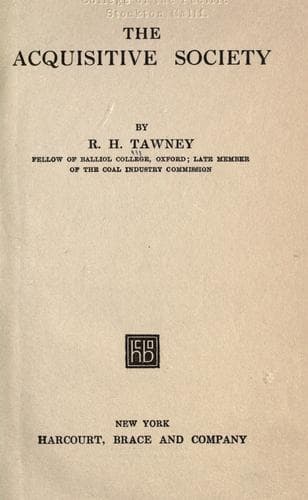
The Acquisitive SocietyTawney, R. H. (Richard Henry)
Philosophy
The Acquisitive Society
Tawney, R. H. (Richard Henry)
Economics; Industries; Social problems
wealth, it is not a paradox, but the statement of an elementary
economic truism to say that active and constructive co-operation on the
part of the rank and file of workers would do more to contribute to
that result than the discovery of a new coal-field or a generation of
scientific invention.
The first condition of enlisting on the side of constructive work the
professional feeling which is now apathetic, or even hostile to it, is
to secure that when it is given its results accrue to the public, not
to the owner of property in capital, in land, or in other resources.
For this reason the attenuation of the rights at present involved in
the private ownership of industrial capital, or their complete
abolition, is not the demand of idealogues, but an indispensable
element in a policy of economic efficiency, since it is the condition
of the most effective functioning of the human beings upon whom,
though, like other truisms, it is often forgotten, {148} economic
efficiency ultimately depends. But it is only one element.
Co-operation may range from mere acquiescence to a vigilant and zealous
initiative. The criterion of an effective system of administration is
that it should succeed in enlisting in the conduct of industry the
latent forces of professional pride to which the present industrial
order makes little appeal, and which, indeed, Capitalism, in its war
upon trade union organization, endeavored for many years to stamp out
altogether.
Nor does the efficacy of such an appeal repose upon the assumption of
that "change in human nature," which is the triumphant _reductio ad
absurdum_ advanced by those who are least satisfied with the working of
human nature as it is. What it does involve is that certain elementary
facts should be taken into account, instead of, as at present, being
ignored. That all work is distasteful and that "every man desires to
secure the largest income with the least effort" may be as axiomatic as
it is assumed to be. But in practice it makes all the difference to
the attitude of the individual whether the collective sentiment of the
group to which he belongs is on the side of effort or against it, and
what standard of effort it sets. That, as employers complain, the
public opinion of considerable groups of workers is against an
intensification of effort as long as part of its result is increased
dividends for shareholders, is no doubt, as far as mere efficiency is
concerned, the gravest indictment of the existing industrial order.
But, even when public ownership has taken the place of private
capitalism, its ability to command {149} effective service will depend
ultimately upon its success in securing not merely that professional
feeling is no longer an opposing force, but that it is actively
enlisted upon the side of maintaining the highest possible standard of
efficiency which can reasonably be demanded.
Public-domain text, read in full here on John Shaqi.
Reviews
Reviews
No reviews yet
Be the first to share your thoughts on this work.
Elsewhere in the archive
Join the Discussion
Join the discussion
Sign in to leave a comment or review.
Sign InorCreate an account