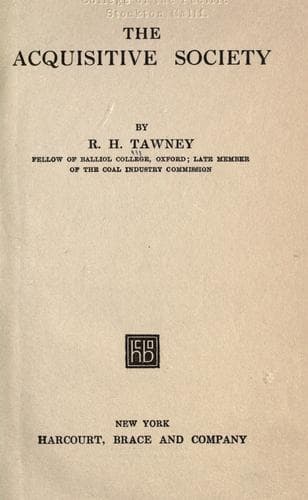
The Acquisitive SocietyTawney, R. H. (Richard Henry)
Philosophy
The Acquisitive Society
Tawney, R. H. (Richard Henry)
Economics; Industries; Social problems
The truth is that we ought radically to revise the presuppositions as
to human motives on which current presentations of economic theory are
ordinarily founded and in terms of which the discussion of economic
question is usually carried on. The assumption that the stimulus of
imminent personal want is either the only spur, or a sufficient spur,
to productive effort is a relic of a crude psychology which has little
warrant either in past history or in present experience. It derives
what plausibility it possesses from a confusion between work in the
sense of the lowest _quantum_ of activity needed to escape actual
starvation, and the work which is given, irrespective of the fact that
elementary wants may already have been satisfied, through the natural
disposition of ordinary men to maintain, and of extraordinary {159} men
to improve upon, the level of exertion accepted as reasonable by the
public opinion of the group of which they are members. It is the old
difference, forgotten by society as often as it is learned, between the
labor of the free man and that of the slave. Economic fear may secure
the minimum effort needed to escape economic penalties. What, however,
has made progress possible in the past, and what, it may be suggested,
matters to the world to-day, is not the bare minimum which is required
to avoid actual want, but the capacity of men to bring to bear upon
their tasks a degree of energy, which, while it can be stimulated by
economic incentives, yields results far in excess of any which are
necessary merely to avoid the extremes of hunger or destitution.
That capacity is a matter of training, tradition and habit, at least as
much as of pecuniary stimulus, and the ability of a professional
association representing the public opinion of a group of workers to
raise it is, therefore, considerable. Once industry has been liberated
from its subservience to the interests of the functionless
property-owner, it is in this sphere that trade unions may be expected
increasingly to find their function. Its importance both for the
general interests of the community and for the special interests of
particular groups of workers can hardly be exaggerated. Technical
knowledge and managerial skill are likely to be available as readily
for a committee appointed by the workers in an industry as for a
committee appointed, as now, by the shareholders. But it is more and
more evident to-day that the crux of the economic situation is not
{160} the technical deficiencies of industrial organization, but the
growing inability of those who direct industry to command the active
good will of the _personnel_. Their co-operation is promised by the
conversion of industry into a profession serving the public, and
promised, as far as can be judged, by that alone.
Public-domain text, read in full here on John Shaqi.
Reviews
Reviews
No reviews yet
Be the first to share your thoughts on this work.
Elsewhere in the archive
Join the Discussion
Join the discussion
Sign in to leave a comment or review.
Sign InorCreate an account