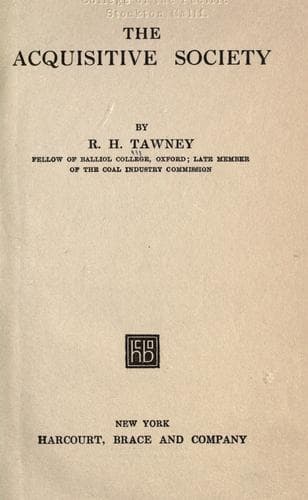
The Acquisitive SocietyTawney, R. H. (Richard Henry)
Philosophy
The Acquisitive Society
Tawney, R. H. (Richard Henry)
Economics; Industries; Social problems
It would be foolish to suggest that any considerable body of men are
uninfluenced by economic considerations. But to represent them as
amenable to such incentives only is to give a quite unreal and bookish
picture of the actual conditions under which the work of the world is
carried on. How large a part such considerations play varies from one
occupation to another, according to the character of the work which it
does and the manner in which it is organized. In what is called _par
excellence_ industry, calculations of pecuniary gain and loss are more
powerful than in most of the so-called professions, though even in
industry they are more constantly present to the minds of the business
men who "direct" it, than to those of the managers and technicians,
most of whom are paid fixed salaries, or to the rank and file of
wage-workers. In the professions of teaching and medicine, in many
branches of the {158} public service, the necessary qualities are
secured, without the intervention of the capitalist employer, partly by
pecuniary incentives, partly by training and education, partly by the
acceptance on the part of those entering them of the traditional
obligations of their profession as part of the normal framework of
their working lives. But this difference is not constant and
unalterable. It springs from the manner in which different types of
occupation are organized, on the training which they offer, and the
_morale_ which they cultivate among their members. The psychology of a
vocation can in fact be changed; new motives can be elicited, provided
steps are taken to allow them free expression. It is as feasible to
turn building into an organized profession, with a relatively high code
of public honor, as it was to do the same for medicine or teaching.
Public-domain text, read in full here on John Shaqi.
Reviews
Reviews
No reviews yet
Be the first to share your thoughts on this work.
Elsewhere in the archive
Join the Discussion
Join the discussion
Sign in to leave a comment or review.
Sign InorCreate an account