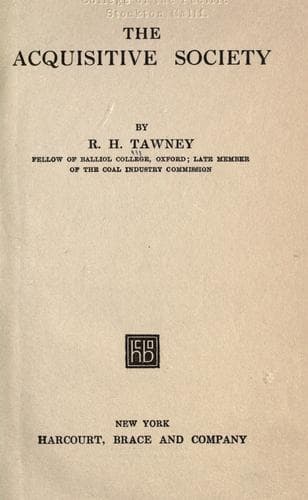
The Acquisitive SocietyTawney, R. H. (Richard Henry)
Philosophy
The Acquisitive Society
Tawney, R. H. (Richard Henry)
Economics; Industries; Social problems
From the conversion of industry into a profession those who at present
do its intellectual work have as much to gain as the manual workers.
For the principle of function, for which we have pleaded as the basis
of industrial organization, supplies the only intelligible standard by
which the powers and duties of the different groups engaged in industry
can be determined. At the present time no such standard exists. The
social order of the pre-industrial era, of which faint traces have
survived in the forms of academic organization, was marked by a careful
grading of the successive stages in the progress from apprentice to
master, each of which was distinguished by clearly defined rights and
duties, varying from grade to grade and together forming a hierarchy of
functions. The industrial system which developed in the course of the
nineteenth century did not admit any principle of organization other
than the convenience of the individual, who by enterprise, skill, good
fortune, unscrupulous energy or mere nepotism, happened at any moment
to be in a position to wield economic authority. His powers were what
he could exercise; his rights were what at any time he could assert.
The Lancashire mill-owner of the fifties was, like the Cyclops, a law
unto himself. Hence, since subordination and discipline are
indispensable in any complex undertaking, the subordination which
emerged in industry was that of servant to master, and the discipline
such as economic strength could impose upon economic weakness.
Public-domain text, read in full here on John Shaqi.
Reviews
Reviews
No reviews yet
Be the first to share your thoughts on this work.
Elsewhere in the archive
Join the Discussion
Join the discussion
Sign in to leave a comment or review.
Sign InorCreate an account