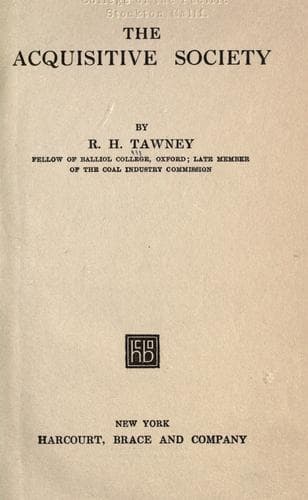
The Acquisitive SocietyTawney, R. H. (Richard Henry)
Philosophy
The Acquisitive Society
Tawney, R. H. (Richard Henry)
Economics; Industries; Social problems
The alternative to the allocation of power by the struggle of
individuals for self-aggrandizement is its {164} allocation according
to function, that each group in the complex process of production
should wield so much authority as, and no more authority than, is
needed to enable it to perform the special duties for which it is
responsible. An organization of industry based on this principle does
not imply the merging of specialized economic functions in an
undifferentiated industrial democracy, or the obliteration of the brain
workers beneath the sheer mass of artisans and laborers. But it is
incompatible with the unlimited exercise of economic power by any class
or individual. It would have as its fundamental rule that the only
powers which a man can exercise are those conferred upon him in virtue
of his office. There would be subordination. But it would be
profoundly different from that which exists to-day. For it would not
be the subordination of one man to another, but of all men to the
purpose for which industry is carried on. There would be authority.
But it would not be the authority of the individual who imposes rules
in virtue of his economic power for the attainment of his economic
advantage. It would be the authority springing from the necessity of
combining different duties to attain a common end. There would be
discipline. But it would be the discipline involved in pursuing that
end, not the discipline enforced upon one man for the convenience or
profit of another. Under such an organization of industry the brain
worker might expect, as never before, to come to his own. He would be
estimated and promoted by his capacity, not by his means. He would be
less likely than at present to find doors closed to him because of
poverty. His {165} judges would be his colleagues, not an owner of
property intent on dividends. He would not suffer from the perversion
of values which rates the talent and energy by which wealth is created
lower than the possession of property, which is at best their pensioner
and at worst the spend-thrift of what intelligence has produced. In a
society organized for the encouragement of creative activity those who
are esteemed most highly will be those who create, as in a world
organized for enjoyment they are those who own.
Public-domain text, read in full here on John Shaqi.
Reviews
Reviews
No reviews yet
Be the first to share your thoughts on this work.
Elsewhere in the archive
Join the Discussion
Join the discussion
Sign in to leave a comment or review.
Sign InorCreate an account