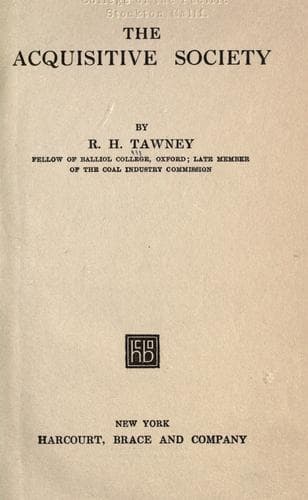
The Acquisitive SocietyTawney, R. H. (Richard Henry)
Philosophy
The Acquisitive Society
Tawney, R. H. (Richard Henry)
Economics; Industries; Social problems
Such considerations are too general and abstract to carry conviction.
Greater concreteness may be given them by comparing the present
position of mine-managers with that which they would occupy were effect
given to Mr. Justice Sankey's scheme for the nationalization of the
Coal Industry. A body of technicians who are weighing the probable
effects of such a reorganization will naturally consider them in
relation both to their own professional prospects and to the efficiency
of the service of which they are the working heads. They will properly
take into account questions of salaries, pensions, security of status
and promotion. At the same time they will wish to be satisfied as to
points which, though not less important, are less easily defined.
Under which system, private or public ownership, will they have most
personal discretion or authority over the conduct of matters within
their professional competence? Under which will they have the best
guarantees that their special knowledge will carry due weight, and
that, when handling matters of art, they will not be overridden or
obstructed by amateurs?
{166}
As far as the specific case of the Coal Industry is concerned the
question of security and salaries need hardly be discussed. The
greatest admirer of the present system would not argue that security of
status is among the advantages which it offers to its employees. It is
notorious that in some districts, at least, managers are liable to be
dismissed, however professionally competent they may be, if they
express in public views which are not approved by the directors of
their company. Indeed, the criticism which is normally made on the
public services, and made not wholly without reason, is that the
security which they offer is excessive. On the question of salaries
rather more than one-half of the colliery companies of Great Britain
themselves supplied figures to the Coal Industry Commission.[1] If
their returns may be trusted, it would appear that mine-managers are
paid, as a class, salaries the parsimony of which is the more
surprising in view of the emphasis laid, and quite properly laid, by
the mine-owners on the managers' responsibilities. The service of the
State does not normally offer, and ought not to offer, financial prizes
comparable with those of private industry. But it is improbable, had
the mines been its property during {167} the last ten years, that more
than one-half the managers would have been in receipt of salaries of
under L301 per year, and of less than L500 in 1919, by which time
prices had more than doubled, and the aggregate profits of the
mine-owners (of which the greater part was, however, taken by the State
in taxation) had amounted in five years to L160,000,000. It would be
misleading to suggest that the salaries paid to mine-managers are
typical of private industry, nor need it be denied that the probable
effect of turning an industry into a public service would be to reduce
Public-domain text, read in full here on John Shaqi.
Reviews
Reviews
No reviews yet
Be the first to share your thoughts on this work.
Elsewhere in the archive
Join the Discussion
Join the discussion
Sign in to leave a comment or review.
Sign InorCreate an account