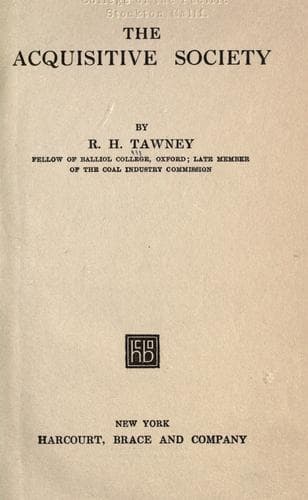
The Acquisitive SocietyTawney, R. H. (Richard Henry)
Philosophy
The Acquisitive Society
Tawney, R. H. (Richard Henry)
Economics; Industries; Social problems
Other examples of the manner in which the control of {174} production
by "business" cuts across the line of economic progress are the wastes
of competitive industry and the profits of monopoly. It is well known
that the price paid by the consumer includes marketing costs, which to
a varying, but to a large, extent are expenses not of supplying the
goods, but of supplying them under conditions involving the expenses of
advertisement and competitive distribution. For the individual firm
such expenses, which enable it to absorb part of a rival's trade, may
be an economy: to the consumer of milk or coal--to take two flagrant
instances--they are pure loss. Nor, as is sometimes assumed, are such
wastes confined to distribution. Technical reasons are stated by
railway managers to make desirable a unification of railway
administration and by mining experts of mines. But, up to the war,
business considerations maintained the expensive system under which
each railway company was operated as a separate system, and still
prevent collieries, even collieries in the same district, from being
administered as parts of a single organization. Pits are drowned out
by water, because companies cannot agree to apportion between them the
costs of a common drainage system; materials are bought, and products
sold, separately, because collieries will not combine; small coal is
left in to the amount of millions of tons because the most economical
and technically efficient working of the seams is not necessarily that
which yields the largest profit to the business men who control
production. In this instance the wide differences in economic strength
which exist between different mines discourage the unification which is
economically desirable; naturally the {175} directors of a company
which owns "a good thing" do not desire to merge interests with a
company working coal that is poor in quality or expensive to mine.
When, as increasingly happens in other industries, competitive wastes,
or some of them, are eliminated by combination, there is a genuine
advance in technical efficiency, which must be set to the credit of
business motives. In that event, however, the divergence between
business interests and those of the consumers is merely pushed one
stage further forward; it arises, of course, over the question of
prices. If any one is disposed to think that this picture of the
economic waste which accompanies the domination of production by
business interests is overdrawn, he may be invited to consider the
criticisms upon the system passed by the "efficiency engineers," who
are increasingly being called upon to advise as to industrial
organization and equipment. "The higher officers of the corporation,"
writes Mr. H. L. Gantt of a Public Utility Company established in
America during the war, "have all without exception been men of the
'business' type of mind, who have made their success through
financiering, buying, selling, etc....
Public-domain text, read in full here on John Shaqi.
Reviews
Reviews
No reviews yet
Be the first to share your thoughts on this work.
Elsewhere in the archive
Join the Discussion
Join the discussion
Sign in to leave a comment or review.
Sign InorCreate an account