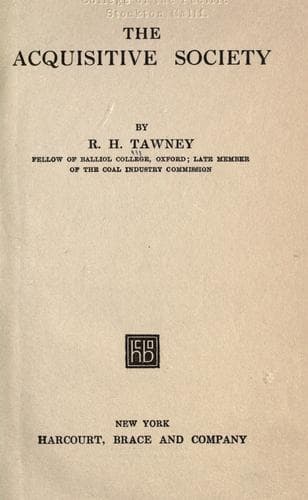
The Acquisitive SocietyTawney, R. H. (Richard Henry)
Philosophy
The Acquisitive Society
Tawney, R. H. (Richard Henry)
Economics; Industries; Social problems
The enjoyment of property and the direction of industry are considered,
in short, to require no social justification, because they are regarded
as rights which stand by their own virtue, not functions to be judged
by the success with which they contribute to a social purpose. To-day
that doctrine, if intellectually discredited, is still the practical
foundation of social {25} organization. How slowly it yields even to
the most insistent demonstration of its inadequacy is shown by the
attitude which the heads of the business world have adopted to the
restrictions imposed on economic activity during the war. The control
of railways, mines and shipping, the distribution of raw materials
through a public department instead of through competing merchants, the
regulation of prices, the attempts to check "profiteering"--the
detailed application of these measures may have been effective or
ineffective, wise or injudicious. It is evident, indeed, that some of
them have been foolish, like the restriction of imports when the world
has five years' destruction to repair, and that others, if sound in
conception, have been questionable in their execution. If they were
attacked on the ground that they obstruct the efficient performance of
function--if the leaders of industry came forward and said generally,
as some, to their honor, have:--"We accept your policy, but we will
improve its execution; we desire payment for service and service only
and will help the state to see that it pays for nothing else"--there
might be controversy as to the facts, but there could be none as to the
principle.
Public-domain text, read in full here on John Shaqi.
Reviews
Reviews
No reviews yet
Be the first to share your thoughts on this work.
Join the Discussion
Join the discussion
Sign in to leave a comment or review.
Sign InorCreate an account