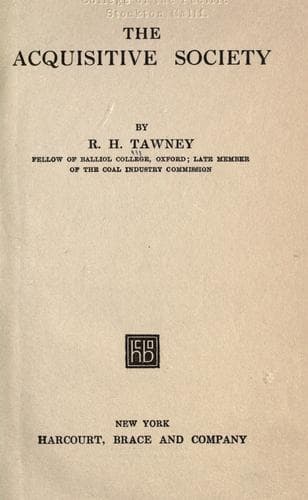
The Acquisitive SocietyTawney, R. H. (Richard Henry)
Philosophy
The Acquisitive Society
Tawney, R. H. (Richard Henry)
Economics; Industries; Social problems
That motive produces industrial warfare, not as a regrettable incident,
but as an inevitable result. It produces industrial war, because its
teaching is that each individual or group has a right to what they can
get, and denies that there is any principle, other than the mechanism
of the market, which determines what {41} they ought to get. For,
since the income available for distribution is limited, and since,
therefore, when certain limits have been passed, what one group gains
another group must lose, it is evident that if the relative incomes of
different groups are not to be determined by their functions, there is
no method other than mutual self-assertion which is left to determine
them. Self-interest, indeed, may cause them to refrain from using
their full strength to enforce their claims, and, in so far as this
happens, peace is secured in industry, as men have attempted to secure
it in international affairs, by a balance of power. But the
maintenance of such a peace is contingent upon the estimate of the
parties to it that they have more to lose than to gain by an overt
struggle, and is not the result of their acceptance of any standard of
remuneration as an equitable settlement of their claims. Hence it is
precarious, insincere and short. It is without finality, because there
can be no finality in the mere addition of increments of income, any
more than in the gratification of any other desire for material goods.
When demands are conceded the old struggle recommences upon a new
level, and will always recommence as long as men seek to end it merely
by increasing remuneration, not by finding a principle upon which all
remuneration, whether large or small, should be based.
Such a principle is offered by the idea of function, because its
application would eliminate the surpluses which are the subject of
contention, and would make it evident that remuneration is based upon
service, {42} not upon chance or privilege or the power to use
opportunities to drive a hard bargain. But the idea of function is
incompatible with the doctrine that every person and organization have
an unlimited right to exploit their economic opportunities as fully as
they please, which is the working faith of modern industry; and, since
it is not accepted, men resign themselves to the settlement of the
issue by force, or propose that the State should supersede the force of
private associations by the use of its force, as though the absence of
a principle could be compensated by a new kind of machinery. Yet all
the time the true cause of industrial warfare is as simple as the true
cause of international warfare. It is that if men recognize no law
superior to their desires, then they must fight when their desires
collide. For though groups or nations which are at issue with each
other may be willing to submit to a principle which is superior to them
both, there is no reason why they should submit to each other.
Public-domain text, read in full here on John Shaqi.
Reviews
Reviews
No reviews yet
Be the first to share your thoughts on this work.
Join the Discussion
Join the discussion
Sign in to leave a comment or review.
Sign InorCreate an account