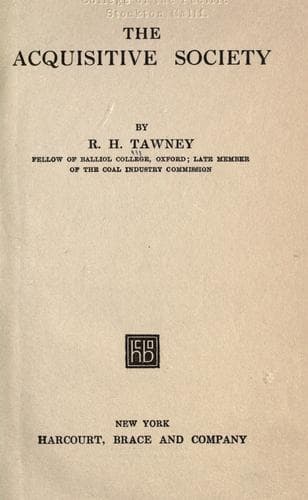
The Acquisitive SocietyTawney, R. H. (Richard Henry)
Philosophy
The Acquisitive Society
Tawney, R. H. (Richard Henry)
Economics; Industries; Social problems
William and Robert Cecil were sagacious and responsible men, and their
view that the protection of property should be accompanied by the
enforcement of obligations upon its owners was shared by most of their
contemporaries. The idea that the institution of private property
involves the right of the owner to use it, or refrain from using it, in
such a way as he may please, and that its principal significance is to
supply him with an income, irrespective of any duties which he may
discharge, would not have been understood by most public men of that
age, and, if understood, would have been repudiated with indignation by
the more reputable among them. They found the meaning of property in
the public purposes to which it contributed, whether they were the
production of food, as among the peasantry, or the management of public
affairs, as among the gentry, and hesitated neither to maintain those
kinds of property which met these obligations nor to repress those uses
of it which appeared likely to conflict with them. Property was to be
an aid to creative work, not an alternative to it. The patentee was
secured protection for a new invention, in order to secure him the
fruits of his own brain, but the monopolist who grew {60} fat on the
industry of others was to be put down. The law of the village bound
the peasant to use his land, not as he himself might find most
profitable, but to grow the corn the village needed. Long after
political changes had made direct interference impracticable, even the
higher ranks of English landowners continued to discharge, however
capriciously and tyrannically, duties which were vaguely felt to be the
contribution which they made to the public service in virtue of their
estates. When as in France, the obligations of ownership were
repudiated almost as completely as they have been by the owner of
to-day, nemesis came in an onslaught upon the position of a _noblesse_
which had retained its rights and abdicated its functions. Property
reposed, in short, not merely upon convenience, or the appetite for
gain, but on a moral principle. It was protected not only for the sake
of those who owned, but for the sake of those who worked and of those
for whom their work provided. It was protected, because, without
security for property, wealth could not be produced or the business of
society carried on.
Public-domain text, read in full here on John Shaqi.
Reviews
Reviews
No reviews yet
Be the first to share your thoughts on this work.
Join the Discussion
Join the discussion
Sign in to leave a comment or review.
Sign InorCreate an account