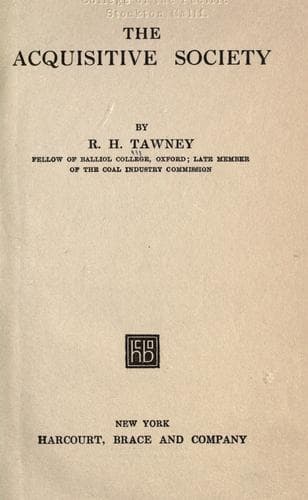
The Acquisitive SocietyTawney, R. H. (Richard Henry)
Philosophy
The Acquisitive Society
Tawney, R. H. (Richard Henry)
Economics; Industries; Social problems
In England the general effect of recent economic development has been
to swell proprietary rights which entitle the owners to payment without
work, and to diminish those which can properly be described as
functional. The expansion of the former, and the process by which the
simpler forms of property have been merged in them, are movements the
significance of which it is hardly possible to over-estimate. There
is, of course, a considerable body of property which is still of the
older type. But though working landlords, and capitalists who manage
their own businesses, are still in the aggregate a numerous body, the
organization for which they stand is not that which is most
representative of the modern economic world. The general tendency for
the ownership and administration of {66} property to be separated, the
general refinement of property into a claim on goods produced by an
unknown worker, is as unmistakable as the growth of capitalist industry
and urban civilization themselves. Villages are turned into towns and
property in land changes from the holding worked by a farmer or the
estate administered by a landlord into "rents," which are advertised
and bought and sold like any other investment. Mines are opened and
the rights of the landowner are converted into a tribute for every ton
of coal which is brought to the surface. As joint-stock companies take
the place of the individual enterprise which was typical of the earlier
years of the factory system, organization passes from the employer who
both owns and manages his business, into the hands of salaried
officials, and again the mass of property-owners is swollen by the
multiplication of _rentiers_ who put their wealth at the disposal of
industry, but who have no other connection with it. The change is
taking place in our day most conspicuously, perhaps, through the
displacement in retail trade of the small shopkeeper by the multiple
store, and the substitution in manufacturing industry of combines and
amalgamations for separate businesses conducted by competing employers.
And, of course, it is not only by economic development that such claims
are created. "Out of the eater came forth meat, and out of the strong
came forth sweetness." It is probable that war, which in barbarous
ages used to be blamed as destructive of property, has recently created
more titles to property than almost all other causes put together.
Public-domain text, read in full here on John Shaqi.
Reviews
Reviews
No reviews yet
Be the first to share your thoughts on this work.
Join the Discussion
Join the discussion
Sign in to leave a comment or review.
Sign InorCreate an account