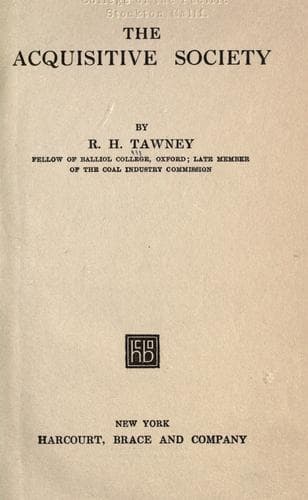
The Acquisitive SocietyTawney, R. H. (Richard Henry)
Philosophy
The Acquisitive Society
Tawney, R. H. (Richard Henry)
Economics; Industries; Social problems
All these rights--royalties, ground-rents, monopoly profits--are
"Property." The criticism most fatal to them is not that of
Socialists. It is contained in the {70} arguments by which property is
usually defended. For if the meaning of the institution is to
encourage industry by securing that the worker shall receive the
produce of his toil, then precisely in proportion as it is important to
preserve the property which a man has in the results of his own
efforts, is it important to abolish that which he has in the results of
the efforts of some one else. The considerations which justify
ownership as a function are those which condemn it as a tax. Property
is not theft, but a good deal of theft becomes property. The owner of
royalties who, when asked why he should be paid L50,000 a year from
minerals which he has neither discovered nor developed nor worked but
only owned, replies "But it's Property!" may feel all the awe which his
language suggests. But in reality he is behaving like the snake which
sinks into its background by pretending that it is the dead branch of a
tree, or the lunatic who tried to catch rabbits by sitting behind a
hedge and making a noise like a turnip. He is practising
protective--and sometimes aggressive--mimicry. His sentiments about
property are those of the simple toiler who fears that what he has sown
another may reap. His claim is to be allowed to continue to reap what
another has sown.
It is sometimes suggested that the less attractive characteristics of
our industrial civilization, its combination of luxury and squalor, its
class divisions and class warfare, are accidental maladjustments which
are not rooted in the center of its being, but are excrescences which
economic progress itself may in time be expected to correct. That
agreeable optimism will not survive an {71} examination of the
operation of the institution of private property in land and capital in
industrialized communities. In countries where land is widely
distributed, in France or in Ireland, its effect may be to produce a
general diffusion of wealth among a rural middle class who at once work
and own. In countries where the development of industrial organization
has separated the ownership of property and the performance of work,
the normal effect of private property is to transfer to functionless
owners the surplus arising from the more fertile sites, the better
machinery, the more elaborate organization. No clearer
exemplifications of this "law of rent" has been given than the figures
supplied to the Coal Industry Commission by Sir Arthur Lowes Dickenson,
which showed that in a given quarter the costs per ton of producing
coal varied from $3.12 to $12 per ton, and the profits from nil to
$4.12. The distribution in dividends to shareholders of the surplus
accruing from the working of richer and more accessible seams, from
special opportunities and access to markets, from superior machinery,
Public-domain text, read in full here on John Shaqi.
Reviews
Reviews
No reviews yet
Be the first to share your thoughts on this work.
Join the Discussion
Join the discussion
Sign in to leave a comment or review.
Sign InorCreate an account