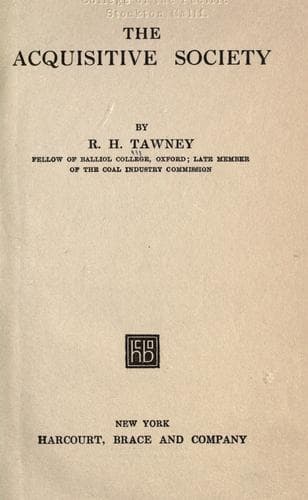
The Acquisitive SocietyTawney, R. H. (Richard Henry)
Philosophy
The Acquisitive Society
Tawney, R. H. (Richard Henry)
Economics; Industries; Social problems
This need for security is fundamental, and almost the gravest
indictment of our civilization is that the mass of mankind are without
it. Property is one way of organizing it. It is quite comprehensible
therefore, that the instrument should be confused with the end, and
that any proposal to modify it should create dismay. In the past,
human beings, roads, bridges and ferries, civil, judicial and clerical
offices, and commissions in the army have all been private property.
Whenever it was proposed to abolish the rights exercised over them, it
was protested that their removal would involve the destruction of an
institution in which thrifty men had invested their savings, and on
which they depended for protection amid the chances of life and for
comfort in old age. In fact, however, property is not the only method
of assuring the future, nor, when it is the way selected, is security
dependent upon the maintenance of all the rights which are at present
normally involved in ownership. In so far as its psychological
foundation is the necessity for securing an income which is stable and
certain, which is forthcoming when its recipient cannot work, and which
can be used to provide for those who cannot provide for themselves,
what is really demanded is not the command over the fluctuating
proceeds of some particular undertaking, which accompanies the
ownership of capital, but the security which is offered by an annuity.
Property is the instrument, security is the object, and when some
alternative way is forthcoming {74} of providing the latter, it does
not appear in practice that any loss of confidence, or freedom or
independence is caused by the absence of the former.
Public-domain text, read in full here on John Shaqi.
Reviews
Reviews
No reviews yet
Be the first to share your thoughts on this work.
Join the Discussion
Join the discussion
Sign in to leave a comment or review.
Sign InorCreate an account