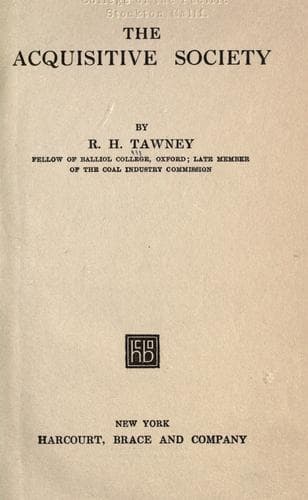
The Acquisitive SocietyTawney, R. H. (Richard Henry)
Philosophy
The Acquisitive Society
Tawney, R. H. (Richard Henry)
Economics; Industries; Social problems
when, as in Lancashire to-day, large blocks of capital change hands at
a period of abnormal activity. The existing shareholders receive the
equivalent of the capitalized expectation of future profits. The
workers, as workers, do not participate in the immense increment in
value; and when, in the future, they demand an advance in wages, they
will be met by the answer that profits, which before the transaction
would have been reckoned large, yield shareholders after it only a low
rate of interest on their investment.
The truth is that whereas in earlier ages the protection of property
was normally the protection of work, the relationship between them has
come in the course of the economic development of the last two
centuries to {79} be very nearly reversed. The two elements which
compose civilization are active effort and passive property, the labor
of human things and the tools which human beings use. Of these two
elements those who supply the first maintain and improve it, those who
own the second normally dictate its character, its development and its
administration. Hence, though politically free, the mass of mankind
live in effect under rules imposed to protect the interests of the
small section among them whose primary concern is ownership. From this
subordination of creative activity to passive property, the worker who
depends upon his brains, the organizer, inventor, teacher or doctor
suffers almost as much embarrassment as the craftsman. The real
economic cleavage is not, as is often said, between employers and
employed, but between all who do constructive work, from scientist to
laborer, on the one hand, and all whose main interest is the
preservation of existing proprietary rights upon the other,
irrespective of whether they contribute to constructive work or not.
Public-domain text, read in full here on John Shaqi.
Reviews
Reviews
No reviews yet
Be the first to share your thoughts on this work.
Join the Discussion
Join the discussion
Sign in to leave a comment or review.
Sign InorCreate an account