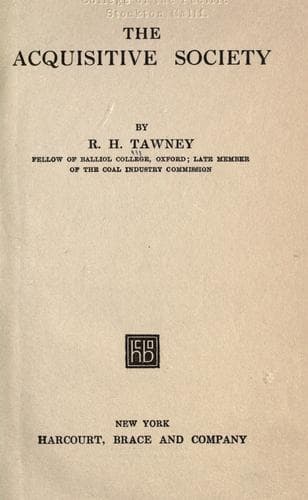
The Acquisitive SocietyTawney, R. H. (Richard Henry)
Philosophy
The Acquisitive Society
Tawney, R. H. (Richard Henry)
Economics; Industries; Social problems
As far as property is concerned, such a policy would possess two edges.
On the one hand, it would aim at abolishing those forms of property in
which ownership is divorced from obligations. On the other hand, it
would seek to encourage those forms of economic organization under
which the worker, whether owner or not, is free to carry on his work
without sharing its control or its profits with the mere _rentier_.
Thus, if in certain {86} spheres it involved an extension of public
ownership, it would in others foster an extension of private property.
For it is not private ownership, but private ownership divorced from
work, which is corrupting to the principle of industry; and the idea of
some socialists that private property in land or capital is necessarily
mischievous is a piece of scholastic pedantry as absurd as that of
those conservatives who would invest all property with some kind of
mysterious sanctity. It all depends what sort of property it is and
for what purpose it is used. Provided that the State retains its
eminent domain, and controls alienation, as it does under the Homestead
laws of the Dominions, with sufficient stringency to prevent the
creation of a class of functionless property-owners, there is no
inconsistency between encouraging simultaneously a multiplication of
peasant farmers and small masters who own their own farms or shops, and
the abolition of private ownership in those industries, unfortunately
to-day the most conspicuous, in which the private owner is an absentee
shareholder.
Public-domain text, read in full here on John Shaqi.
Reviews
Reviews
No reviews yet
Be the first to share your thoughts on this work.
Join the Discussion
Join the discussion
Sign in to leave a comment or review.
Sign InorCreate an account