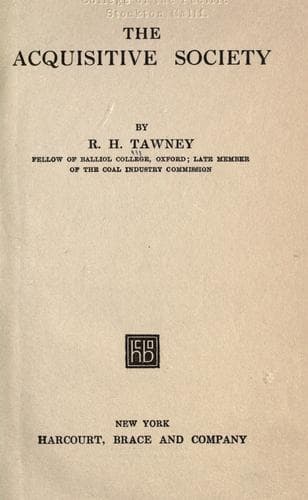
The Acquisitive SocietyTawney, R. H. (Richard Henry)
Philosophy
The Acquisitive Society
Tawney, R. H. (Richard Henry)
Economics; Industries; Social problems
Thus the application to industry of the principle of function involves
an alteration of proprietary rights, because those rights do not
contribute, as they now are, to the end which industry exists to serve.
What gives unity to any activity, what alone can reconcile the
conflicting claims of the different groups engaged in it, is the
purpose for which it is carried on. If men have no common goal it is
no wonder that they should fall out by the way, nor are they likely to
be reconciled by a redistribution of their provisions. If they are not
content both to be servants, one or other must be master, and it is
idle to suppose that mastership can be held in a state of suspense
between the two. There can be a division of functions between
different grades of workers, or between worker and consumer, and each
can {100} have in his own sphere the authority needed to enable him to
fill it. But there cannot be a division of functions between the
worker and the owner who is owner and nothing else, for what function
does such an owner perform? The provision of capital? Then pay him
the sum needed to secure the use of his capital, but neither pay him
more nor admit him to a position of authority over production for which
merely as an owner he is not qualified. For this reason, while an
equilibrium between worker and manager is possible, because both are
workers, that which it is sought to establish between worker and owner
is not. It is like the proposal of the Germans to negotiate with
Belgium from Brussels. Their proposals may be excellent: but it is not
evident why they are where they are, or how, since they do not
contribute to production, they come to be putting forward proposals at
all. As long as they are in territory where they have no business to
be, their excellence as individuals will be overlooked in annoyance at
the system which puts them where they are.
It is fortunate indeed, if nothing worse than this happens. For one
way of solving the problem of the conflict of rights in industry is not
to base rights on functions, as we propose, but to base them on force.
It is to re-establish in some veiled and decorous form the institution
of slavery, by making labor compulsory. In nearly all countries a
concerted refusal to work has been made at one time or another a
criminal offense. There are to-day parts of the world in which
European capitalists, unchecked by any public opinion or authority
{101} independent of themselves, are free to impose almost what terms
they please upon workmen of ignorant and helpless races. In those
districts of America where capitalism still retains its primitive
lawlessness, the same result appears to be produced upon immigrant
workmen by the threat of violence.
Public-domain text, read in full here on John Shaqi.
Reviews
Reviews
No reviews yet
Be the first to share your thoughts on this work.
Elsewhere in the archive
Join the Discussion
Join the discussion
Sign in to leave a comment or review.
Sign InorCreate an account