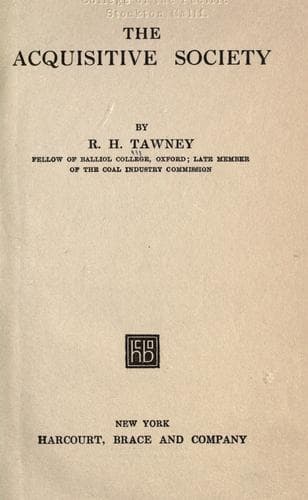
The Acquisitive SocietyTawney, R. H. (Richard Henry)
Philosophy
The Acquisitive Society
Tawney, R. H. (Richard Henry)
Economics; Industries; Social problems
In such circumstances the conflict of rights which finds expression in
industrial warfare does not arise, because the rights of one party have
been extinguished. The simplicity of the remedy is so attractive that
it is not surprising that the Governments of industrial nations should
coquet from time to time with the policy of compulsory arbitration.
After all, it is pleaded, it is only analogous to the action of a
supernational authority which should use its common force to prevent
the outbreak of war. In reality, compulsory arbitration is the
opposite of any policy which such an authority could pursue either with
justice or with hope of success. For it takes for granted the
stability of existing relationships and intervenes to adjust incidental
disputes upon the assumption that their equity is recognized and their
permanence desired. In industry, however, the equity of existing
relationships is precisely the point at issue. A League of Nations
which adjusted between a subject race and its oppressors, between Slavs
and Magyars, or the inhabitants of what was once Prussian Poland and
the Prussian Government, on the assumption that the subordination of
Slavs to Magyars and Poles to Prussians was part of an unchangeable
order, would rightly be resisted by all those who think liberty more
precious than peace. A State which, in the {102} name of peace, should
make the concerted cessation of work a legal offense would be guilty of
a similar betrayal of freedom. It would be solving the conflict of
rights between those who own and those who work by abolishing the
rights of those who work.
Public-domain text, read in full here on John Shaqi.
Reviews
Reviews
No reviews yet
Be the first to share your thoughts on this work.
Elsewhere in the archive
Join the Discussion
Join the discussion
Sign in to leave a comment or review.
Sign InorCreate an account