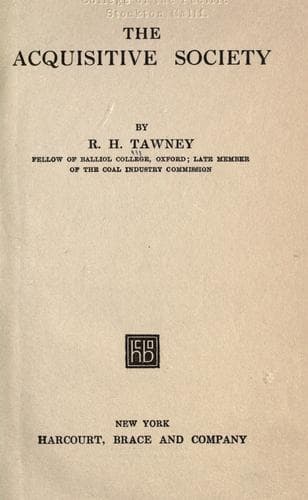
The Acquisitive SocietyTawney, R. H. (Richard Henry)
Philosophy
The Acquisitive Society
Tawney, R. H. (Richard Henry)
Economics; Industries; Social problems
So, when a certain stage of economic development has been reached,
private ownership, by the admission of its defenders, can no longer be
tolerated in the only form in which it is free to display the
characteristic, and quite genuine, advantages for the sake of which it
used to be defended. And, as step by step it is whittled down by tacit
concessions to the practical necessity of protecting the consumer, or
eliminating waste, or meeting the claims of the workers, public
ownership becomes, not only on social grounds, but for reasons of
economic efficiency, the alternative to a type of private ownership
which appears to carry with it few rights of ownership and to be
singularly devoid of privacy. Inevitably and unfortunately the change
must be gradual. But it should be continuous. When, as in the last
few years, the State has acquired the ownership of great masses of
industrial capital, it should retain it, instead of surrendering it to
private capitalists, who protest at once that it will be managed so
inefficiently that it will not pay and managed so efficiently that it
will undersell them. When estates are being broken up and sold, as
they are at present, public bodies should enter the market and acquire
them. Most important of all, the ridiculous barrier, inherited from an
age in which municipal corporations were corrupt oligarchies, which
{121} at present prevents England's Local Authorities from acquiring
property in land and industrial capital, except for purposes specified
by Act of Parliament, should be abolished, and they should be free to
undertake such services as the citizens may desire. The objection to
public ownership, in so far as it is intelligent, is in reality largely
an objection to over-centralization. But the remedy for
over-centralization, is not the maintenance of functionless property in
private hands, but the decentralized ownership of public property, and
when Birmingham and Manchester and Leeds are the little republics which
they should be, there is no reason to anticipate that they will tremble
at a whisper from Whitehall.
Public-domain text, read in full here on John Shaqi.
Reviews
Reviews
No reviews yet
Be the first to share your thoughts on this work.
Elsewhere in the archive
Join the Discussion
Join the discussion
Sign in to leave a comment or review.
Sign InorCreate an account