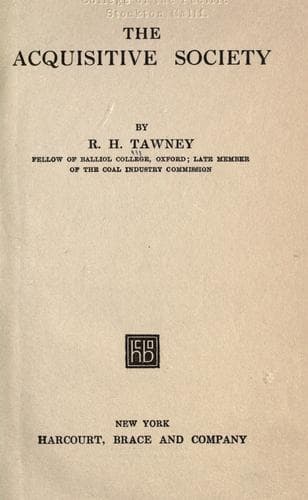
The Acquisitive SocietyTawney, R. H. (Richard Henry)
Philosophy
The Acquisitive Society
Tawney, R. H. (Richard Henry)
Economics; Industries; Social problems
The events of the last few years are a lesson which should need no
repetition. The Government, surprised at the price charged for making
shells at a time when its soldiers were ordered by Headquarters not to
fire more than a few rounds per day, whatever the need for retaliation,
because there were not more than a few to fire, establishes a costing
department to analyze the estimates submitted by manufacturers and to
compare them, item by item, with the costs in its own factories. It
finds that, through the mere pooling of knowledge, {125} "some of the
reductions made in the price of shells and similar munitions," as the
Chartered Accountant employed by the Department tells us, "have been as
high as 50% of the original price." The household consumer grumbles at
the price of coal. For once in a way, amid a storm of indignation from
influential persons engaged in the industry, the facts are published.
And what do they show? That, after 2/6 has been added to the already
high price of coal because the poorer mines are alleged not to be
paying their way, 21% of the output examined by the Commission was
produced at a profit of 1/- to 3/- per ton, 32% at a profit of 3/- to
5/-, 13% at a profit of 5/- to 7/-, and 14% at a profit of 7/- per ton
and over, while the profits of distributors in London alone amount in
the aggregate to over $3,200,000, and the co-operative movement, which
aims not at profit, but at service, distributes household coal at a
cost of from 2/- to 4/- less per ton than is charged by the coal
trade![1]
Public-domain text, read in full here on John Shaqi.
Reviews
Reviews
No reviews yet
Be the first to share your thoughts on this work.
Elsewhere in the archive
Join the Discussion
Join the discussion
Sign in to leave a comment or review.
Sign InorCreate an account