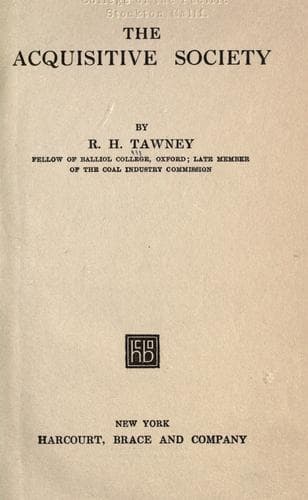
The Acquisitive SocietyTawney, R. H. (Richard Henry)
Philosophy
The Acquisitive Society
Tawney, R. H. (Richard Henry)
Economics; Industries; Social problems
"But these are exceptions." They may be. It is possible that in the
industries, in which, as the recent Committee on Trusts has told us,
"powerful Combinations or Consolidations of one kind or another are in
a position effectively to control output and prices," not only costs
are cut to the bare minimum but profits are inconsiderable. But then
why insist on this humiliating tradition of secrecy with regard to
them, when every one who uses their products, and every one who renders
honest service to production, stands to gain by publicity? If industry
is to become a profession, whatever its {126} management, the first of
its professional rules should be, as Sir John Mann told the Coal
Commission, that "all cards should be placed on the table." If it were
the duty of a Public Department to publish quarterly exact returns as
to costs of production and profits in all the firms throughout an
industry, the gain in mere productive efficiency, which should appeal
to our enthusiasts for output, would be considerable; for the
organization whose costs were least would become the standard with
which all other types of organization would be compared. The gain in
_morale_, which is also, absurd though it may seem, a condition of
efficiency, would be incalculable. For industry would be conducted in
the light of day. Its costs, necessary or unnecessary, the
distribution of the return to it, reasonable or capricious, would be a
matter of common knowledge. It would be held to its purpose by the
mere impossibility of persuading those who make its products or those
who consume them to acquiesce, as they acquiesce now, in expenditure
which is meaningless because it has contributed nothing to the service
which the industry exists to perform.
Public-domain text, read in full here on John Shaqi.
Reviews
Reviews
No reviews yet
Be the first to share your thoughts on this work.
Elsewhere in the archive
Join the Discussion
Join the discussion
Sign in to leave a comment or review.
Sign InorCreate an account