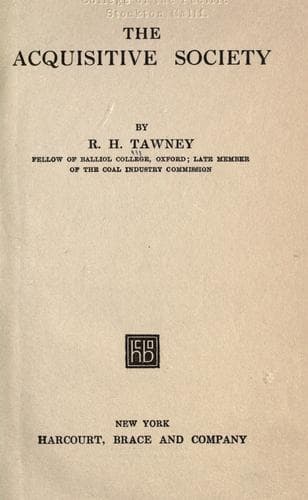
The Acquisitive SocietyTawney, R. H. (Richard Henry)
Philosophy
The Acquisitive Society
Tawney, R. H. (Richard Henry)
Economics; Industries; Social problems
production is not a group, but an individual, with hardly any
government at all. What it does involve is that the individual, merely
by entering the profession should have committed himself to certain
obligations in respect of its conduct, and that the professional
organization, whatever it may be, should have sufficient power to
enable it to maintain them.
The demand for the participation of the workers in the control of
industry is usually advanced in the name of the producer, as a plea for
economic freedom or industrial democracy. "Political freedom," writes
the Final Report of the United States Commission of Industrial
Relations, which was presented in 1916, "can exist only where there is
industrial freedom.... There are now within the body of our Republic
industrial communities which are virtually Principalities, oppressive
to those dependent upon them for a livelihood {129} and a dreadful
menace to the peace and welfare of the nation." The vanity of
Englishmen may soften the shadows and heighten the lights. But the
concentration of authority is too deeply rooted in the very essence of
Capitalism for differences in the degree of the arbitrariness with
which it is exercised to be other than trivial. The control of a large
works does, in fact, confer a kind of private jurisdiction in matters
concerning the life and livelihood of the workers, which, as the United
States' Commission suggests, may properly be described as "industrial
feudalism." It is not easy to understand how the traditional liberties
of Englishmen are compatible with an organization of industry which,
except in so far as it has been qualified by law or trade unionism,
permits populations almost as large as those of some famous cities of
the past to be controlled in their rising up and lying down, in their
work, economic opportunities, and social life by the decisions of a
Committee of half-a-dozen Directors.
Public-domain text, read in full here on John Shaqi.
Reviews
Reviews
No reviews yet
Be the first to share your thoughts on this work.
Elsewhere in the archive
Join the Discussion
Join the discussion
Sign in to leave a comment or review.
Sign InorCreate an account