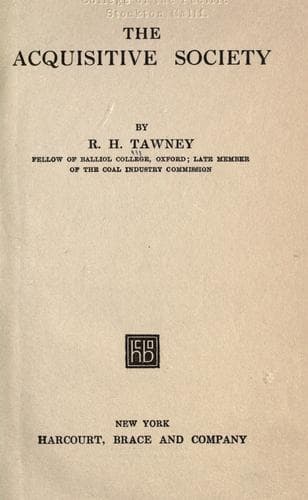
The Acquisitive SocietyTawney, R. H. (Richard Henry)
Philosophy
The Acquisitive Society
Tawney, R. H. (Richard Henry)
Economics; Industries; Social problems
The most conservative thinkers recognize that the present organization
of industry is intolerable in the sacrifice of liberty which it entails
upon the producer. But each effort which he makes to emancipate
himself is met by a protest that if the existing system is incompatible
with freedom, it at least secures efficient service, and that efficient
service is threatened by movements which aim at placing a greater
measure of industrial control in the hands of the workers. The attempt
to drive a wedge between the producer and the consumer is obviously the
cue of all the interests which are conscious that by themselves they
are unable to hold back {130} the flood. It is natural, therefore,
that during the last few months they should have concentrated their
efforts upon representing that every advance in the demands and in the
power of any particular group of workers is a new imposition upon the
general body of the public. Eminent persons, who are not obviously
producing more than they consume, explain to the working classes that
unless they produce more they must consume less. Highly syndicated
combinations warn the public against the menace of predatory
syndicalism. The owners of mines and minerals, in their new role as
protectors of the poor, lament the "selfishness" of the miners, as
though nothing but pure philanthropy had hitherto caused profits and
royalties to be reluctantly accepted by themselves.
The assumption upon which this body of argument rests is simple. It is
that the existing organization of industry is the safeguard of
productive efficiency, and that from every attempt to alter it the
workers themselves lose more as consumers than they can gain as
producers. The world has been drained of its wealth and demands
abundance of goods. The workers demand a larger income, greater
leisure, and a more secure and dignified status. These two demands, it
is argued, are contradictory. For how can the consumer be supplied
with cheap goods, if, as a worker, he insists on higher wages and
shorter hours? And how can the worker secure these conditions, if as a
consumer, he demands cheap goods? So industry, it is thought, moves in
a vicious circle of shorter hours and higher wages and less production,
which in time must mean {131} longer hours and lower wages; and every
one receives less, because every one demands more.
Public-domain text, read in full here on John Shaqi.
Reviews
Reviews
No reviews yet
Be the first to share your thoughts on this work.
Elsewhere in the archive
Join the Discussion
Join the discussion
Sign in to leave a comment or review.
Sign InorCreate an account