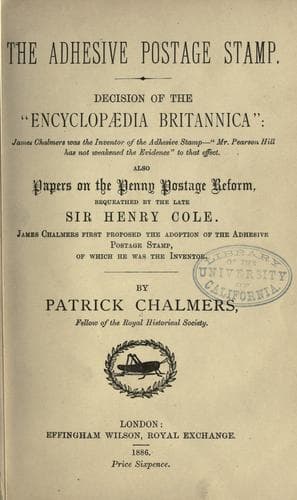
Chalmers, James, 1782-1853; Hill, Rowland, Sir, 1795-1879; Postage stamps
Such is the letter or extract which, placed in the hands of every editor
in London, has led to my statements being here treated with comparative
neglect.[9] But let my statements equally with those of Mr. Pearson
Hill be read by any impartial writer, as in the case of the
"Encyclopædia Britannica," afterwards noticed, and the result, it will
be seen, is to lead to an entirely different conclusion. "James Chalmers
was the inventor of the adhesive postage stamp--Mr. Pearson Hill has not
weakened the evidence to that effect." Here was honesty
certainly--simplicity indeed--on the side of Mr. Chalmers; but what
about the representation on the part of Mr. Hill? Was it the case that
he had proposed the adoption of the adhesive stamp in February, 1837, as
represented to Mr. Chalmers? The proofs to the contrary are conclusive.
Mr. Hill had made a passing allusion to an adhesive stamp in February,
1837, but _only_ a passing allusion. Nothing can be more clear than that
the adoption of the adhesive stamp for the purpose of carrying out his
scheme formed no part of the original proposals and intentions of Mr.
Hill. His representation to Mr. Chalmers was therefore exaggerated,
delusive, and misleading.[10] "Why did not you tell me anything of this
before?" replies Mr. Chalmers in effect;--"_there_ is a copy of your
letter of 3rd March, 1838, when I sent you my plan, in which letter of
yours no such pretensions were put forward. It is only now that I learn
for the first time that you had ever proposed or been in favour of an
adhesive stamp. Further, how is it that neither of these members of the
Committee before whom I laid my plan had ever heard of any such prior
proposal on your part? However, I am now only sorry at having troubled
you--I have at least the satisfaction of knowing that the public have
got my plan somehow."
"Why did you not tell me anything of this before?" Why indeed! Because
Mr. Hill _then_ had not contemplated an adhesive stamp, as has been
abundantly proved. An impressed stamped cover "was absolutely to be used
in all cases," says the Chancellor of the Exchequer as late as in July,
1839--a "power" was asked for this, and for this alone. (See _ante_,
page 14.) But much had happened in the interval betwixt Mr. Hill's two
letters to Mr. Chalmers. The stamp not accepted by Mr. Hill in 1838 had
become in 1840 the favourite of all opinions concerned, the adopted of
the Treasury. It had saved his scheme. Mr. Chalmers must now be put
aside, a matter which the entire contrast betwixt the dispositions of
the two men rendered only too easy, and so this afterthought, this
far-fetched pretext already noticed, was hit upon for the purpose.
At the same time Mr. Chalmers appears to have been too apathetic in the
matter, indifferent to personal considerations so long as the public
got his stamp from some quarter; but the absence of any desire for
personal advantage is a not unfrequent characteristic in those who have
done some public service.
Public-domain text, read in full here on John Shaqi.
Reviews
Reviews
No reviews yet
Be the first to share your thoughts on this work.
Join the Discussion
Join the discussion
Sign in to leave a comment or review.
Sign InorCreate an account