British -- Asia -- Fiction; Man-woman relationships -- Fiction; Soldiers -- Fiction
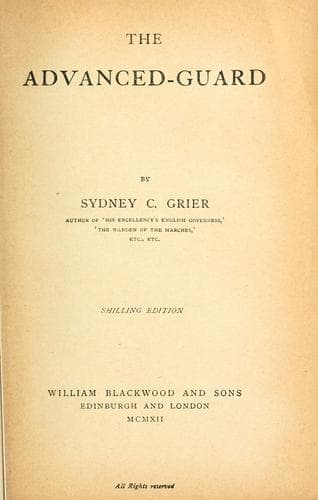
The
Advanced-Guard
BY
SYDNEY C. GRIER
AUTHOR OF ‘HIS EXCELLENCY’S ENGLISH GOVERNESS,’
‘THE WARDEN OF THE MARCHES,’
ETC., ETC.
(_Third in the Modern East series_)
_SHILLING EDITION_
WILLIAM BLACKWOOD AND SONS
EDINBURGH AND LONDON
MCMXII
_All Rights reserved_
CONTENTS.
I. LADY HAIGH’S KIND INTENTIONS
II. THE AUTOCRAT
III. A BLANK SHEET
IV. UNSTABLE
V. COLIN AS AMBASSADOR
VI. MOUNTING IN HOT HASTE
VII. EYE-WITNESS
VIII. SEEING AND BELIEVING
IX. COUNSEL FOR THE PROSECUTION
X. ARRAIGNED
XI. JUSTIFIED
XII. WHAT MIGHT HAVE BEEN
XIII. THE DIE IS CAST
XIV. INTO THE TERRIBLE LAND
XV. A LAND OF DARKNESS AND THE SHADOW OF DEATH
XVI. “ENGLAND’S FAR, AND HONOUR A NAME”
XVII. THE STRENGTH OF TEN
XVIII. THE ALLOTTED FIELD
XIX. A WOUNDED SPIRIT
XX. THE ISLE OF AVILION
XXI. FIRE AND SWORD
XXII. TAKEN BY SURPRISE
XXIII. PRISONERS AND CAPTIVES
XXIV. RAHMAT-ULLAH
XXV. THE RIGHT PREVAILS
XXVI. “FOR THINE AND THEE”
XXVII. AFTER TOIL--TOIL STILL
FOOTNOTES
THE ADVANCED-GUARD.
CHAPTER I.
LADY HAIGH’S KIND INTENTIONS.
Fifty years ago the great port of Bab-us-Sahel was in its infancy.
The modern ranges of wharfs and breakwaters were represented by a
single half-finished pier, and vessels still discharged their
passengers and cargo a mile from shore, to the imminent peril of life
and property. The province of Khemistan had only recently come under
British rule, by an operation which was variously described as “the
most shameless piece of iniquity ever perpetrated,” and “the
inevitable working of the laws of right and justice”; and the
iron-willed, iron-handed old soldier who had perpetrated the iniquity
and superintended the working of the laws was determined to open up
the country from the river to the desert and beyond. His enemies were
numerous and loud-voiced and near at hand; his friends, with the
exception of his own subordinates, few and far away; but he had one
advantage more common in those days than these, a practically free
hand. Under “the execrable tyranny of a military despotism,” the
labour of pacification and the construction of public works went on
simultaneously, and although the Bombay papers shrieked themselves
hoarse in denouncing Sir Henry Lennox, and danced war-dances over his
presumably prostrate form, no one in Khemistan was a penny the
worse--a fact which did not tend to mollify the angry passions
concerned.
Public-domain text, read in full here on John Shaqi.
Reviews
Reviews
No reviews yet
Be the first to share your thoughts on this work.
Join the Discussion
Join the discussion
Sign in to leave a comment or review.
Sign InorCreate an account