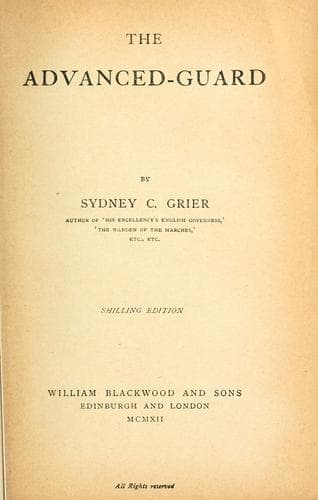
British -- Asia -- Fiction; Man-woman relationships -- Fiction; Soldiers -- Fiction
“But as she isn’t, the whole force would waste their time dangling
round her,” was the crushing reply. “No, Lady Haigh, we have no use
for young ladies on the frontier. It will be work, not play.”
“Play! Do you think a girl with that face wants to spend her life in
playing?” demanded Lady Haigh, very much in the tone with which she
had once been wont to crush her family. “Look there!”
She drew him to the open window of the drawing-room and made him look
through the reed curtain. The light fell full on Penelope’s face as
she sang, and Lady Haigh felt that the beholder was impressed.
“What’s that she’s singing?” he growled. “‘County Guy’? Scott? There’s
some good in her, at any rate.”
Lady Haigh forbore to resent the slighting imputation, and Major
Keeling remained watching the singer through the curtain. Penelope’s
contemporaries considered her tall and queenly, though she would now
be thought decidedly under middle height. Her dark hair was dressed in
a graceful old fashion which had almost gone out before the combined
assault of bands and ringlets,--raised high on the head, divided in
front, and slightly waved on the temples,--a style which by rights
demanded an oval face and classical features as its complement. Judged
by this standard, Penelope might have been found wanting, for her
features were at once stronger and less regular than the classical
ideal; but the grey eyes beneath the broad low brow disarmed
criticism, they were so large and deep and calm, save when they were
lighted, as now, by the fire of the ballad she was singing. Those were
days when a white dress and coloured ribbons were considered the only
evening wear for a young girl; and Penelope wore a vivid scarlet sash,
with knots of scarlet catching up her airy white draperies, and a
scarlet flower in her hair. As Major Keeling stood looking at her,
Lady Haigh caught a murmur which at once astonished and delighted her.
“That is a woman who would help a man--not drag him back.” Then,
apparently realising that he had spoken aloud, he added hastily, “Yes,
yes, as you say. But who’s the man with the unlucky face?”
His finger indicated a tall thin youth who stood behind the singer.
The face was a remarkable one, thin and hawklike, with a high forehead
and closely compressed lips. The hair and small moustache were fair
and reddish in tint, the eyes grey, with a curious look of aloofness
instead of the keenness that would have seemed to accord with the rest
of the features.
“That? Why, that’s Colin Ross, Penelope’s brother. What is there
unlucky about him?”
“Oh, nothing--merely a look. Her brother, do you say?”
“Yes, her twin brother. But what look do you mean? Oh, you must tell
me, Major Keeling, or I shall tell Penelope that you say her brother
has an unlucky face.”
“You will do nothing of the kind. Hush! don’t attract their attention.
I can’t explain it: I have seen it in several men--not many,
fortunately--and it has always meant an early and violent death.”
Public-domain text, read in full here on John Shaqi.
Reviews
Reviews
No reviews yet
Be the first to share your thoughts on this work.
Join the Discussion
Join the discussion
Sign in to leave a comment or review.
Sign InorCreate an account