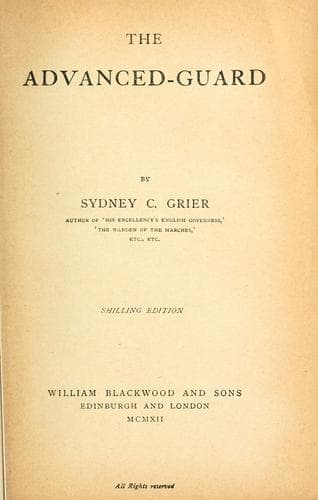
British -- Asia -- Fiction; Man-woman relationships -- Fiction; Soldiers -- Fiction
Ferrers’ departure from Alibad, hurried and almost ignominious as it
was, was not wholly without its compensations, for Penelope and he
were drawn nearer together than ever before by their common anxiety
about Colin. Ferrers was so genuinely anxious and distressed for his
friend that he could think of nothing else, and his farewells to
Penelope consisted almost entirely of charges to take care of Colin,
and to let him know exactly how he was getting on. Penelope was not
likely to resent this preoccupation--indeed, she caught herself
reflecting what a sympathising friend she might have been to Ferrers
if he had not insisted upon being regarded as a lover,--and she parted
from him with kinder feelings than she would have thought possible
before. Thus he started on his journey to the river, whence he was to
cross the desert to the eastward and to travel to Calcutta, so as to
receive his orders and credentials from the Government before he
betook himself beyond the bounds of civilisation. Major Keeling saw
him depart with unconcealed pleasure, and promptly ordered up from the
river to replace him a young officer on whom he had had his eye for
some time, sowing the seeds of future trouble by seconding him from
his regiment and appointing him to the Khemistan Horse on his own
authority.
As for Ferrers, he discovered very soon that his mission was not
likely to be either an easy or a particularly glorious one. When the
unfortunate Lieutenant Whybrow had disappeared, the Government
expressed its official regret at his probable fate, and seemed to
think it had done all that could be expected of it. But Whybrow had
possessed relations and many friends, and these were so unreasonable
as to hold the opinion that the Government was responsible for the
lives of its accredited agents. They induced a section of the home
press to take up the subject, and there was something like an
agitation about it in London. Finding that it was not to be left
alone, the Government decided on a compromise. Nothing but
overwhelming physical force could bring the fanatics of Gamara to
their knees, and this could only have been applied by an army, under
the command of Sir Henry Lennox or an officer of his calibre, whose
calculated rashness might, like Faith, “laugh at impossibilities, and
say, It shall be done.” But no one would have ventured to propose such
an expedition at this time, and it was therefore determined to try
moral suasion once more. Ferrers was supplied with the means of
obtaining abundance of money (which was to be rigorously accounted
for), but denied an escort; instructed to obtain the release of
Whybrow, if he was still alive, by all possible means, but strictly
forbidden to indulge in threats which might seem to pledge the
Government to take action. To most people the affair seemed hopeless
from the first; but Ferrers’ failing was not a lack of
self-confidence, and he felt that he had it in him to secure success
Public-domain text, read in full here on John Shaqi.
Reviews
Reviews
No reviews yet
Be the first to share your thoughts on this work.
Elsewhere in the archive
Join the Discussion
Join the discussion
Sign in to leave a comment or review.
Sign InorCreate an account