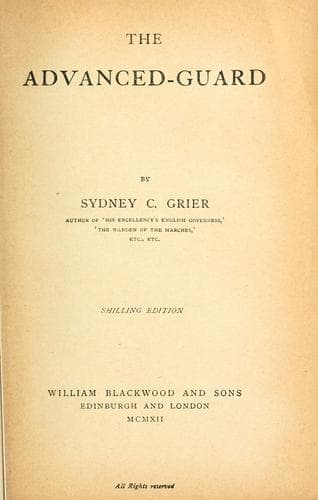
British -- Asia -- Fiction; Man-woman relationships -- Fiction; Soldiers -- Fiction
where other men would only suffer signal defeat.
His journey to Gamara seemed to justify him in this opinion, for it
was a triumph of what a later age has learnt to call bluff. Taking
with him only his personal servants, he attached himself, for the
greater part of the way, to a trading caravan, and speedily made
himself the chief person in it. It could only be some very important
man, with unlimited power behind him, who would dare to adopt such an
insolent demeanour, and bully his travelling companions so
unconcernedly, thought the merchants. Somewhat sulkily they accepted
him at his own valuation, and the marches and halting-places came to
be settled by reference to him. He it was also who rebuked the guides
when it was necessary, bringing those haughty mountaineers to reason
by displaying a proficiency in many-tongued abuse which astonished
them, and who forced the headmen of inhospitable villages to turn out
of their own houses for his accommodation. True, the merchants
sometimes looked forward with misgiving to the next time they would
traverse these regions, when there would be no champion to help them;
but such a splendid opportunity of paying off old grudges was not to
be let slip, and the caravan led by the overbearing Farangi was long a
proverb on the route.
When the mountains had been crossed, and the irrigated plains of
Gamara were in view, the caravan broke up into several portions, and
Ferrers pursued his way to the city in company with one of these. His
heart was high, for his reputation had preceded him, and the villagers
received him with marked respect. It was clear, he thought, that the
men who went before him had failed by going to work too gently, and
truckling to the prejudices of the people. The right thing was to go
on one’s way regardless of opposition, to browbeat the haughty and
meet the insolent with an insolence greater than their own, and in
general to act as no sane man, alone and without support in a hostile
country, could be expected to act. The natives, like his
fellow-travellers, would conclude that he had some mysterious reserve
of strength, or he could never be so bold. Thus he saw without
misgiving the distant masses of green which marked the neighbourhood
of the city, and rode calmly along the narrow dikes, which were the
only roads between the sunken fields, without a thought of turning
back while there was time. Dimly seen through their screen of trees,
the brick towers and earthen ramparts of Gamara had nothing very
terrible about them, and was not Ferrers entering the place as an
accredited envoy, with permission from the Khan to reside there until
the business on which he came was done? Even the contemptible little
dispute into which he was forced by the action of the officials at the
gate, who wished to make him dismount from his horse, did not trouble
him. What did it signify that the law of Gamara forbade a Christian to
ride in her streets? He, at least, was going to ride where he liked,
Public-domain text, read in full here on John Shaqi.
Reviews
Reviews
No reviews yet
Be the first to share your thoughts on this work.
Elsewhere in the archive
Join the Discussion
Join the discussion
Sign in to leave a comment or review.
Sign InorCreate an account