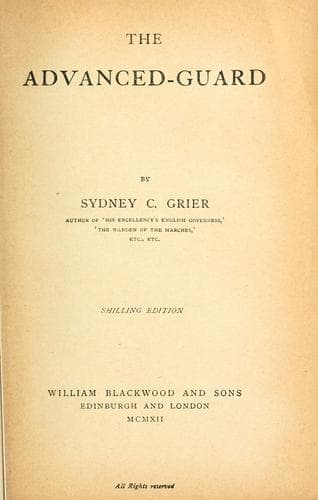
British -- Asia -- Fiction; Man-woman relationships -- Fiction; Soldiers -- Fiction
“Ah, I thought so. Sort of place that there’s some credit in being
jolly in--eh, Mrs Mark Tapley? Whenever I find Elma in uproariously
good spirits, I know she is utterly miserable, and trying to spare my
feelings. Wish I had the gift of cheerfulness. The Chief has been
biting our heads off all round this morning.”
“Yes, we saw him. What is the matter with him?” cried Lady Haigh and
Penelope together.
“Well, it’s a good thing you ladies didn’t run across him just now.
You’ve defeated one of his most cherished schemes. He meant to blow up
the fort and use the materials for housebuilding, but he was kind
enough to remember that either tents or mud huts would be fairly
uncomfortable for you, so he spared the old place until we could get a
roof over our heads. But meanwhile the Government heard of his
intention, and forbade him to destroy such an interesting relic, so
the new canal has to make a big bend, and all his plans are thrown
out. And as if that wasn’t enough, in comes a _cossid_ [messenger]
this morning with letters from Sir Henry, hinting that his differences
with the Government are so acute that he feels he’ll be forced to
resign, and then we are safe to have a wretched civilian over us. Of
course the Chief feels it, and we’ve felt it too.”
“Poor Major Keeling! I feel quite guilty,” said Lady Haigh.
“Oh, you needn’t. You’ll have a crow to pluck with him when I tell you
why he sent me that order to hurry on from the river. It was simply
and solely to test you--to see if you would keep your promise. If you
had protested and raised a storm, Tarleton had orders to pack you both
down-stream again immediately.”
“Really! To lay traps for one in that way!” Indignation choked Lady
Haigh’s utterance, and she rode on in wrathful silence while her
husband pointed out to Penelope the line of the projected roads and
canals, now only indicated by rows of stakes, the young trees just
planted in sheltered spots, and carefully fenced in against goats and
firewood-seekers, and the rising walls or mere foundations of various
large buildings. Crossing an open space, dotted with the dark tents
and squabbling children of a wandering tribe of gipsy origin, they
rode in at the gateway of the fort, where the great doors hung idly
against the wall, unguarded even by a sentry. Sir Dugald helped the
ladies to dismount, and led them into the first of a range of lofty,
thick-walled rooms, freshly white-washed.
“You’ll be in clover here,” he said. “The heat in the tents is like
nothing on earth. The Chief is a perfect salamander; but your brother,
Miss Ross, has been living under his table with a wet quilt over it,
and I have scooped out a burrow for myself in the ground under my
tent. Porter” (the Engineer officer already mentioned) “makes his boy
pour water over him every night when he goes to bed, so as to get an
hour or so of coolness. By the bye, Elma, the Chief and Ross and
Tarleton are coming to dine with us to-night.”
Public-domain text, read in full here on John Shaqi.
Reviews
Reviews
No reviews yet
Be the first to share your thoughts on this work.
Join the Discussion
Join the discussion
Sign in to leave a comment or review.
Sign InorCreate an account