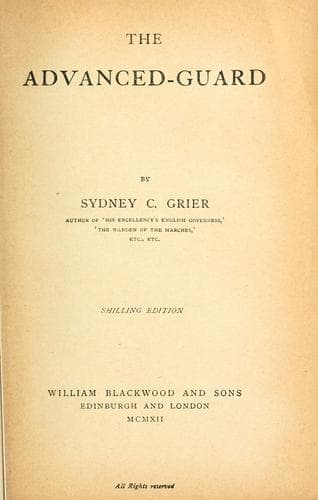
British -- Asia -- Fiction; Man-woman relationships -- Fiction; Soldiers -- Fiction
So black was the outlook that Colonel Keeling thought it would be well
to send the ladies down as far as the river, at any rate; but they
rebelled, pointing out that such a step would cause the natives to
despair of the British cause. Lady Haigh flatly refused to go;
Penelope said she would go if her husband wished it, but entreated so
piteously to be allowed to stay that he, dreading the journey for her,
and little able to spare an escort, consented on the condition that
she left off visiting the native town to take help to the sufferers
there. After all, it was Lady Haigh who was seized with fever and had
to be nursed by Penelope, and she was scarcely convalescent when the
two husbands were obliged to leave Alibad once more under the
protection of the ever-useful Fencibles, and march to the north-east
to repel Gobind Chand. The old Hindu had developed a remarkable power
of generalship at this stage in his career. He refused steadily to
come out on the plains, or even to show his full strength in the
hills. His plan was to lead the small British force a weary dance
through broken country, eluding capture when it seemed inevitable that
he must be caught, and watching for an opportunity of surprising the
weary and dispirited troops.
But it was such an emergency as this that brought out the strongest
points in Colonel Keeling’s character. To find in the ex-Vizier a
foeman worthy of his steel sent his spirits up with a rush; and, as he
had no intention of playing into Gobind Chand’s hands, a very short
experience determined him to strike out tactics of his own. Somehow or
other it became known in the British camp that Colonel Keeling felt
considerable anxiety as to the good faith of Nalapur, now that he was
so far from Alibad. What could be easier than for the Sheikh-ul-Jabal
to swoop down on the practically defenceless town and level it with
the ground? Hence it was very natural that the Commandant should
divide his force, sending back the larger portion, under Major Porter,
for the defence of the town, and retaining only one gun and a small
number of troops for the pursuit of Gobind Chand. Whether Colonel
Keeling had exercised his reputed powers, and actually detected spies
among his camp-followers, or was merely making a bold guess, certain
it is that two or three individuals who had attached themselves to the
British force in order to assure the Commandant that the number of
Gobind Chand’s adherents had been grossly exaggerated, contrived to
become separated from it in the darkness, and by inadvertence, no
doubt, to fall in with the enemy’s scouts, and relate what Kīlin
Sahib was doing. Therefore, as Porter marched away with his force, and
the dust of their passage was seen vanishing in the direction of
Alibad, Gobind Chand was able to concentrate his men round the hollow
in which the British camp lay. Incautious as Colonel Keeling might
have been, he was not the man to be taken by surprise, and he broke
Public-domain text, read in full here on John Shaqi.
Reviews
Reviews
No reviews yet
Be the first to share your thoughts on this work.
Elsewhere in the archive
Join the Discussion
Join the discussion
Sign in to leave a comment or review.
Sign InorCreate an account