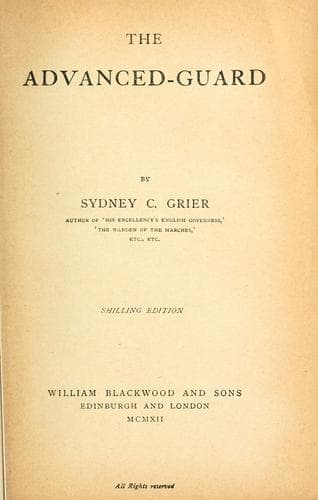
British -- Asia -- Fiction; Man-woman relationships -- Fiction; Soldiers -- Fiction
camp in some haste, and effected a safe retreat. But this retreat was
in itself an encouragement to the enemy--especially since the British
force did not make for the plains, but seemed fated to wander farther
into the hills--and Gobind Chand followed close upon its heels. At
evening things looked very black for Colonel Keeling. He and his small
body of men were holding a low hill which was commanded on all sides
by higher hills. The valley surrounding it had only one opening, that
to the north, by which he had entered, and across which Gobind Chand
was now encamped, and it seemed quite clear that he had been caught in
a _cul-de-sac_. He was clearly determined to fight to the last,
however, for his men kept up a perfect pandemonium of noise at
intervals all night. They fired volleys at imaginary enemies,
performed trumpet fantasias at unseemly hours, and dragged their
solitary gun, with much difficulty and noise, from place to place on
the crest of the hill, apparently to find out where it would be of
most service. In the morning Colonel Keeling looked at Sir Dugald and
laughed.
“It’s Gobind Chand or me to-day,” he said. “If he doesn’t advance into
the valley in half an hour, we are done.”
Before the specified time had elapsed, however, the vanguard of Gobind
Chand’s force was pouring into the valley, the besieged keeping their
gun for use later. Taking advantage of the cover afforded by the rocks
with which the valley was strewn, the enemy, cautious in spite of
their superiority of numbers, settled down to “snipe” at the hill-top.
Colonel Keeling was radiant, and his men needed nothing to complete
their happiness when they heard him muttering concerning “stainless
Tunstall’s banner white,” “priests slain on the altar-stone,”
“Fontarabian echoes,” and other things outside their ken. Suddenly, as
he was making the round of the hill-top, and pushing his men down into
cover, for the twentieth time, he found himself confronted by one of
his own _chaprasis_ from Alibad, who, with a respectfully immobile
face, held forth a letter. The Commandant turned it over as if he was
afraid to open it.
“How did you get here, Rahim Khan?” he asked.
“By a rope from the top of the cliff, sahib.”
“Fool! could the enemy see you?”
“Nay, sahib; I was hidden by this hill as I crossed the valley.”
No further reason for delay offering itself, Colonel Keeling turned
his back upon the man and opened the letter. As he drew out the
enclosure his hands shook and his dark face was white. As if by main
force he unfolded the paper and held it before his eyes, which refused
at first to convey any meaning to his mind:--
“Alibad. 1 A.M.
“Daughter born shortly before midnight; fine healthy child. Mrs
Keeling doing well.
“J. Tarleton.”
An exclamation of thankfulness broke from the Commandant, and he
brushed something from his eyes before turning again to the
_chaprasi_.
Public-domain text, read in full here on John Shaqi.
Reviews
Reviews
No reviews yet
Be the first to share your thoughts on this work.
Elsewhere in the archive
Join the Discussion
Join the discussion
Sign in to leave a comment or review.
Sign InorCreate an account