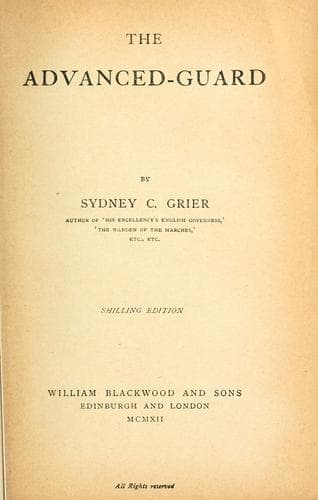
British -- Asia -- Fiction; Man-woman relationships -- Fiction; Soldiers -- Fiction
“‘I was in the city of Gamara a year ago, when there was much talk
concerning Firoz Khan, the Farangi chief of his Highness’s bodyguard,
who had disappeared. Some said he had been secretly slain, others that
he had been sent on a private errand by his Highness. One day there
was proclamation made throughout the city that two men were to be put
to death in the palace square,--one a Christian, the other one who had
embraced Islam and relapsed into his idolatry. Many desired to see the
sight, and among those that found standing-room in the square was I.
Now when the prisoners were led forth there was much astonishment
among the people, for one of them was Firoz Khan; and those that
looked upon him said that he bore the marks of torture. And the other
was an old man and bent, blind also, and walking with difficulty, who
they said had dwelt in the dungeons for many years. It was noticed
that no offer of life was made to these prisoners, nor were any
questions put to them; moreover, his Highness’s face was black towards
every one on whom his eye lighted. But the prisoners spoke to one
another in English,--which tongue I understand, having studied it in
India,--and the one said, “I am a Christian, and a Christian I die,”
and the other, kissing him upon the forehead, said, “George, we shall
meet in Paradise, in the presence of God,” and turning to the people
he cried, in a voice of extraordinary strength: “Tell the English that
this man, who for his life’s sake gave up Christ, now for Christ’s
sake gives up his life.” And when his voice was heard there fell a
terror on the people, for they said it was a young Farangi that had
long ago disappeared, whom they counted to be inspired of God, and
there arose murmurings, so that his Highness commanded the
executioners to do their duty at once; and the heads of the two men
were struck off with a great sword, and their bodies foully dealt
with, as is the wont in Gamara. I know no more concerning them.’”
General Keeling ceased reading, and his eyes and Sir Dugald’s met. For
a moment neither spoke.
“I suppose there can’t be much doubt that it’s true?” said Sir Dugald
at last.
“None, I should say; but we can’t expect positive proof.”
Public-domain text, read in full here on John Shaqi.
Reviews
Reviews
No reviews yet
Be the first to share your thoughts on this work.
Elsewhere in the archive
Join the Discussion
Join the discussion
Sign in to leave a comment or review.
Sign InorCreate an account