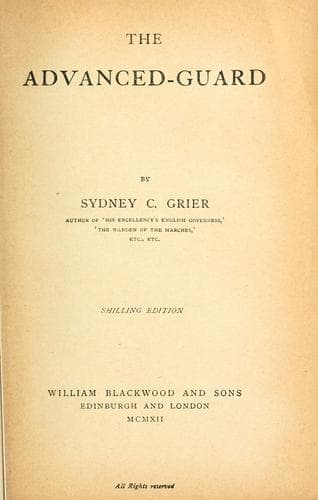
British -- Asia -- Fiction; Man-woman relationships -- Fiction; Soldiers -- Fiction
“It’s a curious thing,” said Sir Dugald, with some hesitation, “but
when I told my wife, on the voyage to the Cape, what you had told me
about Ferrers’ turning up again, she said at once that she believed
poor Ross was alive still. She meant to tell you herself--it didn’t
seem quite the sort of thing to write about--but when she was watching
beside Mrs Keeling the day she died, she saw her smile when they
thought she was insensible, and heard her say quite strongly, ‘They
are all there, my father and mother, and my little sister who
died--all waiting for me, but not Colin. Elma, where is Colin?’ My
wife said something--you know the sort of thing women would say in
answer to a thing of the kind--but when she thought it over, it
occurred to her that it must mean Ross was not dead. That again is no
proof, of course, but it’s curious.”
“Very strange,” agreed General Keeling. “Haigh, the more I think of
it, the more I feel certain the Jew’s story was true. What conceivable
motive could the man have for inventing it? He didn’t know that I had
any particular interest in the poor fellows. Poor fellows! it’s
blasphemy to call them that. Colin was a true martyr, if ever man was,
and as for Ferrers----”
“Nothing in his life became him like the leaving of it,” supplied Sir
Dugald.
“Nothing; but what a miracle it seems that he was able to seize the
chance! I sometimes ask myself whether I could have done what either
of them did--lived out those years of martyrdom like Colin, or gone
back to certain torture and death like Ferrers. We are poor creatures,
Haigh, the best of us, and those of whom we expect least sometimes
shame us by what they do. Well, they have seen the end of it now, I
suppose--‘in Paradise, in the presence of God.’ As for me,” he added
with a half-laugh, as he turned to lock up the paper again, “I’m
afraid I shouldn’t be happy, even in Paradise, if I couldn’t take a
look at the frontier now and then, and make sure it was getting on all
right. Why, Missy, what do you want?”
The little girl had crept up to them as they talked, and was standing
with something clasped to her breast, looking in wonder at their moved
faces. As her father spoke, she held out shyly to Sir Dugald a large
octagonal tile, covered with a beautiful iridescent glaze, in a
peculiarly delicate shade of turquoise. “For Godmamma,” she said, and
retreated promptly.
“Why, Missy, isn’t that the slab on which you mix your medicines?”
asked her father, capturing her. A nod was the only answer. “It’s one
of her greatest treasures,” he explained to Sir Dugald. “The men find
them sometimes in the ruined forts round here, but it’s very seldom
they come on one unbroken, and the man who found this one brought it
to her. You really want your Godmamma to have it, Missy?” Another nod.
“Well, Haigh, I wouldn’t burden you with it if I didn’t think Lady
Haigh would really like it. These things are thought a good deal of.”
Public-domain text, read in full here on John Shaqi.
Reviews
Reviews
No reviews yet
Be the first to share your thoughts on this work.
Elsewhere in the archive
Join the Discussion
Join the discussion
Sign in to leave a comment or review.
Sign InorCreate an account