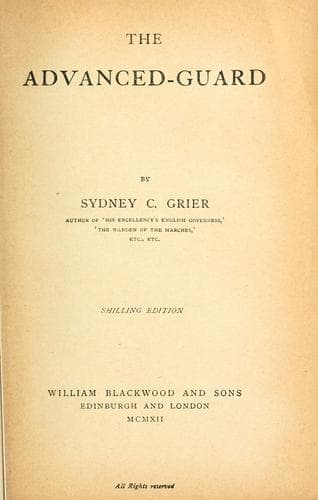
British -- Asia -- Fiction; Man-woman relationships -- Fiction; Soldiers -- Fiction
The fashion among the young officers at Bab-us-Sahel at this time
might be said to run in the direction of slumming. The example had
been set a year or two before by a young man of brilliant talents and
unscrupulous audacity, whose delight it was to escape from
civilisation and live among the natives as one of themselves. This man
was the despair of his seniors, but in the course of his escapades he
contrived to pick up much curious and some useful information. To
follow in his footsteps meant to defy the authorities now and possibly
gain credit later, and this was sufficiently good reason for doing so.
In the case of men of less brilliance or less audacity the natural
result was merely to lead them into places they had much better have
shunned, and acquaint them with persons whom it would have been wiser
not to know. Ferrers was one of those who had followed the pioneer’s
example without gaining the slightest advantage, and he knew this; so
that when the chance of freeing himself came to him, he was almost
ready to welcome it. Almost, but not quite. It so happened that a rule
had lately been introduced requiring a literary knowledge of the local
language from officers employed in the province. Major Keeling, while
remarking to Ferrers, with his usual contempt for the actions of his
official superiors, that in his opinion a colloquial acquaintance with
it was all that was really needed, advised him to take a munshi with
him to Shah Nawaz, and employ his leisure there in study. No sooner
had the advice been given than the munshi presented himself in the
person of one of Ferrers’ disreputable associates, the Mirza
Fazl-ul-Hacq. Originally a Mohammedan religious teacher, this man was
in some way under a cloud, and was regarded by his co-religionists
much as an unfrocked clergyman would be in England. This fact was in
itself an attraction to Ferrers and the young men of his stamp, to
whom there was an actual delight in finding that one who ought to be
holy had gone wrong, and the Mirza professed a strong attachment to
him in return. Now he begged to be allowed to accompany him to the
frontier as his munshi, asserting, with perfect truth, that he was
well acquainted with all the dialects in use there. Ferrers, who had
begun to look back regretfully at the pleasures from which he was to
be torn, closed with the offer, and the Mirza was duly enrolled in his
retinue. The two were closeted together in all Ferrers’ hours of
leisure at Shah Nawaz, but remarkably little study was accomplished.
The Mirza was an adept at various games of chance, he brewed delicious
sherbets (not without the assistance of beverages forbidden by his
religion), and he was a fascinating story-teller. Thoroughly worthless
as Ferrers knew him to be, the man had made himself necessary to him,
and he half hated, half condoned, the fact. When a fellow led such a
dog’s life, how could he refuse any chance of congenial companionship
that offered itself?
Public-domain text, read in full here on John Shaqi.
Reviews
Reviews
No reviews yet
Be the first to share your thoughts on this work.
Join the Discussion
Join the discussion
Sign in to leave a comment or review.
Sign InorCreate an account