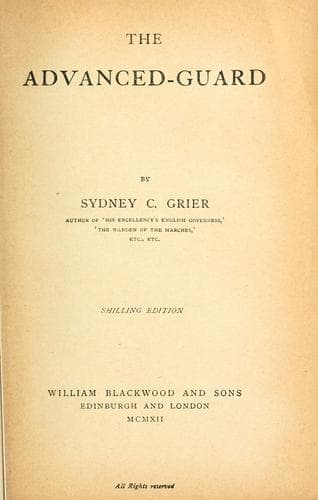
British -- Asia -- Fiction; Man-woman relationships -- Fiction; Soldiers -- Fiction
The Haighs’ house stood on the outskirts of the cantonments. It was a
small white-washed bungalow, remarkable for the extreme neatness of
its compound, and the pathetic attempts at gardening which were
evident wherever any shade might be hoped for. Very widely did it
differ from its nearest neighbour, a rambling, tumble-down cluster of
buildings inhabited by a riotous colony of bachelors, who were
popularly alleged to ride all day and drink all night. In view of the
amount of work exacted by Sir Henry Lennox from all his subordinates,
this was obviously an exaggeration; but the patch of unreclaimed
desert which surrounded Bachelors’ Hall, its broken fences, and the
jagged heaps of empty bottles here and there, distinguished it
sufficiently from the little domain where Sir Dugald and Lady Haigh
were conducting what their friends considered a very risky matrimonial
experiment. The festive young gentlemen next door lavished a good deal
of wonder and pity (as upon a harmless lunatic) upon Sir Dugald. That
a man who was hampered by a title and an unproductive Scotch estate
should let the latter and carry the former into the Indian army, where
it would array all his superiors against him as one man, instead of
remaining at home and using title and estate as a bait for an heiress,
was strange enough. But that he should proceed further to defy the
opinion of those in authority by bringing out a wife--and a plain
wife, without money and with a tongue (the bachelors had learnt
through an indiscreet lady friend that the bride had dubbed their
cheerful establishment “Beer and Skittles”)--seemed to show that he
must be absolutely mad. Lady Haigh’s relations, on the other hand,
regarded her marriage with trembling joy. Girls with aspirations after
higher education were fewer in those days than these, and perplexed
families did not know how to deal with them. By sheer hard fighting
Elma Wargrave had won leave to study at the newly founded Queen’s
College, but her family breathed a sigh of relief when, after less
than a year’s work, she announced that she was going to marry Sir
Dugald Haigh, whom she had met on a vacation visit. Whatever Elma
might take it into her head to do in the future, her husband and not
her parents would be responsible, and it would happen at a distance of
some thousands of miles. The baronetcy was an undeniable fact, and
there was no need to obtrude on people’s attention the other fact that
the bridegroom was merely a subaltern in the Company’s artillery.
Hence, when the wedding had safely taken place, the parents allowed
themselves to rejoice more and tremble less, only hoping that poor Sir
Dugald would not find he had undertaken more than he could manage. It
would have surprised them a good deal to learn that never until this
particular evening had the Haighs known even the semblance of a
serious disagreement. Lady Haigh had taken her young husband’s
measure, and adapted herself to it with a cleverness which was really
Public-domain text, read in full here on John Shaqi.
Reviews
Reviews
No reviews yet
Be the first to share your thoughts on this work.
Join the Discussion
Join the discussion
Sign in to leave a comment or review.
Sign InorCreate an account