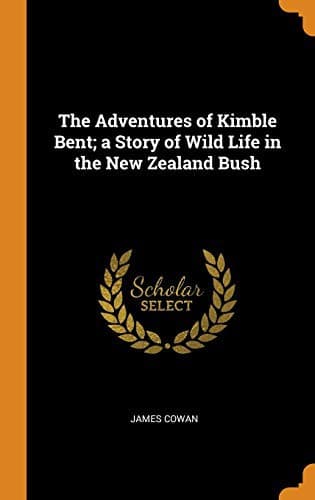
The adventures of Kimble Bent: A story of wild life in the New Zealand bush — John Shaqi
The adventures of Kimble Bent: A story of wild life in the New Zealand bushCowan, James
History
The adventures of Kimble Bent: A story of wild life in the New Zealand bush
Cowan, James
Bent, Kimble, 1837-1916; New Zealand -- Description and travel
On two or three occasions Kimble Bent witnessed the ceremony of the
offering of the _mawé_, the ancient rite of the _Whangai-hau_. The
heart (_manawa_) or other piece of human flesh, was brought into the
_marae_ and given to a man named Tihirua, who was the priest of the
burnt sacrifice. He was a young man about twenty-five years of age,
belonging to the Ngati-Maru tribe, of the Upper Waitara. "He would
take the heart in his hand," says Bent, "and strike a match, or take a
firestick and singe the flesh. When it was slightly scorched he would
throw it away; it was _tapu_ to Uenuku. This was an ancient war-custom
of the Maoris; Titokowaru adopted it because he believed it would cause
the _pakehas_ to lose strength and courage, and become unnerved in
time of battle. After the fight at Papa-tihakehake, in 1868, I saw this
man Tihirua cut a white man's body open outside the _marae_, tear out
the bleeding heart, hold lighted matches underneath it until it was
singed, and then throw it away."[5]
A more frightful scene still that the sun looked down upon in that
forest den was a cannibal feast. On June 12, 1868, a party of about
fifteen Hauhaus from the _pa_, prowling out in the direction of the
Waihi redoubt, cut off and shot and tomahawked a trooper of the
Armed Constabulary, a man named Smith, who had incautiously ventured
out to look for his horse beyond rifle-range of the redoubt. An
Armed Constabulary officer, who happened to be walking across the
parade ground at the time, heard and saw the firing, and with his
field-glasses distinctly saw the flashing of the tomahawks as the
Hauhaus cut the man to pieces. An armed party was immediately sent
out at the double, but all they found when they reached the spot
was half the body! The legs and hips were lying on the trampled and
blood-drenched ground amongst the fern; the head and the upper part
of the body down to the waist had been carried off by the savages,
who had vanished into the forest as quickly as they had come. The
remains of the poor trooper were cooked and eaten by the people in Te
Ngutu-o-te-Manu, after the heart had been offered to Titokowaru's god
of war by the young priest Tihirua.
Titokowaru, according to Bent, did not eat human flesh himself, but
a boastful letter sent by him a few days later to a philo-_pakeha_
chief at Mawhitiwhiti, seems to indicate that he was a cannibal of the
most ferocious sort, unless, as is quite possible, he was speaking of
his people generally when he used the first person singular. In this
letter, addressed to Puano, and dated "Wharé-kura, June 25, 1868," he
wrote this emphatic warning:
Public-domain text, read in full here on John Shaqi.
Reviews
Reviews
No reviews yet
Be the first to share your thoughts on this work.
Join the Discussion
Join the discussion
Sign in to leave a comment or review.
Sign InorCreate an account