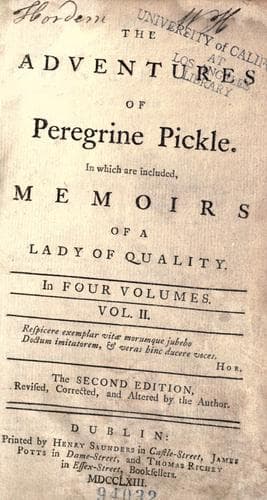
The Adventures of Peregrine PickleSmollett, T. (Tobias)
General
The Adventures of Peregrine Pickle
Smollett, T. (Tobias)
Adventure stories; Fiction; Picaresque literature
I should not have been so severe upon this actor, had I not
seen him extolled by his partisans with the most ridiculous and fulsome
manifestations of praise, even in those very circumstances wherein (as I
have observed) he chiefly failed.”
Peregrine, not a little piqued to hear the qualifications of such a
celebrated actor in England treated with such freedom and disrespect,
answered, with some asperity, that the chevalier was a true critic,
more industrious in observing the blemishes than in acknowledging the
excellence of those who fell under his examination.
It was not to be supposed that one actor could shine equally in all
characters; and though his observations were undoubtedly very judicious,
he himself could not help wondering that some of them had always escaped
his notice, though he had been an assiduous frequenter of the
playhouse. “The player in question,” said he, “has, in your own opinion,
considerable share of merit in the characters of comic life; and as to
the manners of the great personages in tragedy, and the operation of
the grand passions of the soul, I apprehend they may be variously
represented, according to the various complexion and cultivation of
different men, A Spaniard, for example, though impelled by the same
passion, will express it very differently from a Frenchman; and what
is looked upon as graceful vivacity and address by the one, would be
considered as impertinence and foppery by the other; nay, so opposite is
your common deportment from that of some other nations, that one of
our own countrymen, in the relation of his travels, observes, that the
Persians even of this age, when they see any man perform unnecessary
gestures, says he is either a fool or Frenchman. The standard of
demeanour being thus unsettled, a Turk, a Moor, an Indian, or inhabitant
of my country whose customs and dress are widely different from ours,
may, in his sentiments, possess all the dignity of the human heart,
and be inspired by the noblest passion that animates the soul, and yet
excite the laughter rather than the respect of an European spectator.
Public-domain text, read in full here on John Shaqi.
Reviews
Reviews
No reviews yet
Be the first to share your thoughts on this work.
Elsewhere in the archive
Join the Discussion
Join the discussion
Sign in to leave a comment or review.
Sign InorCreate an account