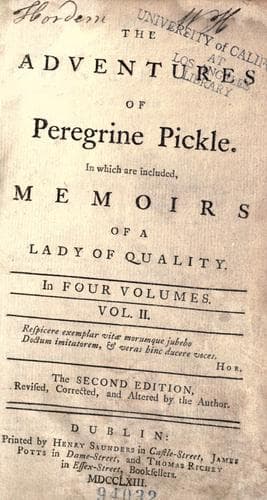
The Adventures of Peregrine PickleSmollett, T. (Tobias)
General
The Adventures of Peregrine Pickle
Smollett, T. (Tobias)
Adventure stories; Fiction; Picaresque literature
“That you have good actors in England,” said he, “it would be unjust
and absurd in me to deny; your theatre is adorned by one woman, whose
sensibility and sweetness of voice is such as I have never observed on
any other stage; she has besides, an elegance of person and expression
of features, that wonderfully adapt her for the most engaging characters
of your best plays; and I must freely own that I have been as highly
delighted and as deeply affected by a Monimia and Belvidera at London,
as ever I was by Cornelia and Cleopatra at Paris. Your favourite actor
is a surprising genius. You can, moreover, boast of several comic actors
who are perfect masters of buffoonery and grimace; though, to be free
with you, I think in these qualifications you are excelled by the
players of Amsterdam. Yet one of your graciosos I cannot admire, in all
the characters he assumes. His utterance is a continual sing-song,
like the chanting of vespers; and his action resembles that of heaving
ballast into the hold of a ship. In his outward deportment he seems to
have confounded the ideas of insolence and the dignity of mien; acts the
crafty cool, designing Crookback, as a loud, shallow, blustering Hector;
in the character of the mild patriot Brutus, loses all temper and
decorum; nay, so ridiculous is the behaviour of him and Cassius at their
interview, that, setting foot to foot, and grinning at each other,
with the aspect of two cobblers engaged, they thrust their left sides
together, with repeated shoots, that the hilts of their swords may clash
for the entertainment of the audience; as if they were a couple of merry
andrews, endeavouring to raise the laugh of the vulgar, on some scaffold
of Bartholomew Fair. The despair of a great man, who falls a victim to
the infernal practices of a subtle traitor who enjoyed his confidence,
this English Aesopus represents, by beating his own forehead, and
beating like a bull; and, indeed, in almost all his most interesting
scenes, performs such strange shakings of the head, and other antic
gesticulations, that when I first saw him act, I imagined the poor man
laboured under the paralytical disorder, which is known by the name
of St. Vitus's dance. In short, he seems to be a stranger to the more
refined sensations of the soul, consequently his expression is of the
vulgar kind, and he must often sink under the idea of the poet; so that
he has recourse to such violence of affected agitation, as imposes upon
the undiscerning spectator; but to the eye of taste, evinces him a mere
player of that class whom your admired Shakespeare justly compares to
Nature's journeyman tearing a passion to rags. Yet this man, in spite of
all these absurdities, is an admirable Falstaff, exhibits the character
of the eighth Henry to the life, is reasonably applauded in the Plain
Dealer, excels in the part of Sir John Brute, and would be equal to many
humorous situations in low comedy, which his pride will not allow him to
undertake.
Public-domain text, read in full here on John Shaqi.
Reviews
Reviews
No reviews yet
Be the first to share your thoughts on this work.
Elsewhere in the archive
Join the Discussion
Join the discussion
Sign in to leave a comment or review.
Sign InorCreate an account