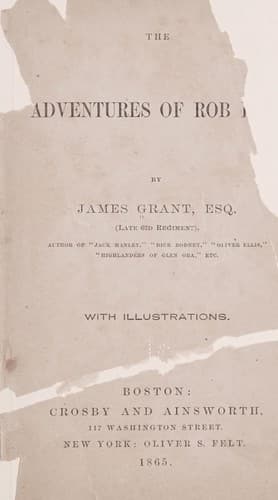
Biographical fiction; Historical fiction; Outlaws -- Fiction; Rob Roy, 1671-1734 -- Fiction; Scotland -- History -- 1689-1745 -- Fiction
At times they would fill their cups to the brim. and standing in a
circle round Morrar na Shean, whose goblet was full of wine, of ale,
and of usquebaugh mixed together, they shouted,--
"Oh! Lord, let the world be turned upside down, that brave men may
make bread out of it!"
And then the cups were drained and, amid wild hurrahs, flung high
into the air.
Morrar na Shean, though he lived in so early an age of Scottish
history, was not without some skill in mechanics, for we are informed
that "there was a chest or some kind of machine fixed in the mouth of
the stream below the castle (of Lochmore), for catching salmon in
their ingress into the loch, or their egress out of it, and that
immediately on the fish being entangled in the machine, the capture
was announced to the family by the ringing of a bell, which the
struggles of the fish set in motion, by means of a fine cord, one end
of which was attached to a bell in the middle of an upper room, and
the other end to the machine in the stream below."
This was an ingenious fish-trap; but while the Lord of the Venison
pursued his more furious sports and drunken orgies, the poor Princess
Gunhilda was left in utter loneliness at the castle of Braal; and the
long nights which her husband spent in roystering among his wild
followers, were passed by her, often in tears, and at the deeply
arched windows of the lofty hall or of her bower chamber, watching
the merry dancers, the streamers of the northern lights, which made
her think of her Danish home, of her mother's farewell kiss, of the
castle of Axel-huis, and the green, waving woods of Zealand.
Harold was soon weary of his wife, for her extreme gentleness tired
him, and he loved her not, though he longed for a son--a little Count
of Orkney--to heir his vast possessions, and in whose baby face he
might see his own ferocious visage reflected.
He prayed at holy wells, and, candle in hand, he went bare-foot in
sackcloth garments, with ashes on his head, to every shrine of
sanctity in the Northern Isles; he sent gifts to Adam the bishop, and
offerings to the altar of St. Magnus at Kirkwall, with silver lamps,
rich garments, candles of perfumed wax, and jars of oil and wine;
seeking in return of the prebendaries only their prayers that he
might have a son; but on the Yule-day of 1153, the countess had a
daughter, whom she named after her mother the queen, Algiva.
Public-domain text, read in full here on John Shaqi.
Reviews
Reviews
No reviews yet
Be the first to share your thoughts on this work.
Elsewhere in the archive
Join the Discussion
Join the discussion
Sign in to leave a comment or review.
Sign InorCreate an account