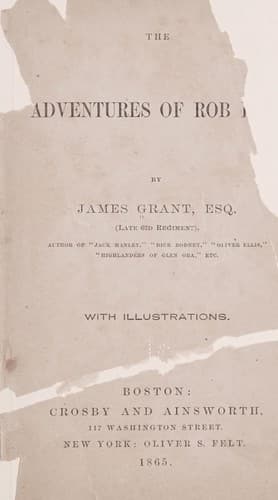
Biographical fiction; Historical fiction; Outlaws -- Fiction; Rob Roy, 1671-1734 -- Fiction; Scotland -- History -- 1689-1745 -- Fiction
We will now proceed to relate how this state of matters came to pass,
and an explanation is the more necessary as it will serve to show the
_secret spring_ of many of Rob Roy's hostile actions,--why he took up
arms against the Government, and how, from being a gentleman farmer
and levier of black-mail, he gradually became a rebel, an outlaw, and
yet a patriot, with a price set upon his head. The clan and surname
of MacGregor are descended from Alpine MacAchai, who was crowned King
of Scotland in 787, hence their motto, "_'S Rioghal mo dhream_,"--"My
race is royal!" They are named the Clan Alpine, and from their
antiquity comes the old Scottish proverb:--
The woods, the waters and Clan Alpine,
Are the oldest things in Albyn.
Long before charters or parchments were known in the North, their
possessions were great; for they held lands in Glendochart,
Strathfillan, Glenorchy, Balquhidder, Breadalbane, and Rannoch, and,
until 1490, Taymouth, too, was theirs. They had four strong castles:
Kilchurn, which crowns an insular rock in Loch Awe, Finlarig, and
Ballach, at the east end of Loch Tay; an old fortress on an isle in
Loch Dochart, and many minor towers.
But when the kings of Scotland sought to introduce into the Highlands
the same feudal system which existed in England, and in their Lowland
territories, and endeavoured to subvert the Celtic or patriarchal law
by substituting Crown charters, which made chiefs into barons, who,
in their single person, thus became lords of all the land in which
their clan had previously a _joint_ right and share,--a right old as
the days of the first settlers on British soil,--a bloody strife
ensued between those who accepted such charters and those who refused
and despised them.
Feuds and local wars began, and all who resisted the King were termed
broken clans, and to be thus stigmatized was tantamount to a
denunciation of outlawry. By their sturdy adherence to the system of
their forefathers, the Clan Alpine soon became eminently obnoxious to
James VI., the meanest monarch that ever occupied a European throne;
the more so, that in 1602, a long and bitter quarrel between them and
the Colquhouns of Luss (who had murdered two wandering MacGregors)
came to a terrible issue in a place called Glenfruin. Its name
signifies the Glen of Sorrow, and it is a deep vale intersected by
the Fruin, and overlooked by ridges of dark heathy mountains, that
are more than eighteen hundred feet in height.
Here, then, on the 9th of February Sir Humphry Colquhoun, of Luss, at
the head of a great force of horse and foot, composed of his own
clan, the Grahames, and the burghers of Dumbarton, under Tobias
Smollet, their provost,--met Alaster Roy MacGregor of Glenstrae, who
had only four hundred swordsmen; but his superior bravery and skill
soon decided the disastrous conflict.
Public-domain text, read in full here on John Shaqi.
Reviews
Reviews
No reviews yet
Be the first to share your thoughts on this work.
Join the Discussion
Join the discussion
Sign in to leave a comment or review.
Sign InorCreate an account